

Short answer
Slab leak repair in Apache Junction turns on precision: finding the leak within a foot before anything is cut is the difference between a contained repair and a room that has to be rebuilt. We use acoustic detection, line tracing and thermal imaging to mark the spot, then price spot repair, reroute or repipe honestly.
Nearly every home in Apache Junction is slab-on-grade. The water lines run through or under a poured concrete floor, which is efficient to build and unforgiving when a line fails. A slab leak can run for months, quietly soaking the soil under your foundation, before anyone notices anything more than a slightly odd water bill.
The whole game with a slab leak is precision. Any plumber can find a leak eventually by opening enough concrete. Finding it within a foot, before anything gets cut, is what separates a contained repair from a room you no longer recognize. We use acoustic listening equipment, pressure isolation testing, line tracing and thermal imaging to pin the location down first.
This is one of the more expensive things that can go wrong in a house, so we will also be direct with you about the options — spot repair, reroute, or repipe — and which one actually makes sense given the age and material of your plumbing.
Warm floor? Water bill up? Let’s find it.
Electronic detection first, cutting second. We mark the spot before anyone touches your concrete.
How a slab leak announces itself
A warm spot on the floor
The classic sign, and it means the leak is on the hot side. Hot lines fail first because heat accelerates the corrosion.
Your water bill jumped with no change in habits
Often the earliest signal. A pinhole under a slab can waste thousands of gallons a month before it does anything you can see.
Running water sound with everything off
Put your ear to the floor in a quiet house. A steady hiss or trickle with every fixture closed is water moving where it should not be.
Cracked or lifting flooring
Tile that pops loose, wood that cups, or carpet with a persistently damp area — all consistent with moisture coming up through the slab.
A musty smell that will not go away
Moisture wicking up through concrete into baseboard and drywall grows mold long before anything looks wet.
Low pressure across the whole house
A significant leak bleeds off system pressure. If everything got weak at once and nothing changed at the street, suspect a leak.
What a slab leak repair job includes
Every quote covers the items below. If something is not on this list, it is not in the price — and we will say so before we start.
Meter test to confirm and quantify
We prove there is a leak and measure the loss rate before anything else — a documented figure that is often decisive for an insurance claim.
Hot side or cold side, isolated
Isolating the water heater halves the search area in a single test, before any equipment comes out.
Line tracing and acoustic pinpointing
Mapping where the pipe actually runs under the slab, then localising the escape point by sound rather than by opening concrete hopefully.
Thermal imaging on hot-side leaks
Confirms the location and shows how far moisture has already travelled through the structure, which is usually further than anyone expects.
Three options, priced separately
Spot repair, overhead reroute or full repipe — with our honest read on which is right given the age and material of the rest of your plumbing.
Concrete and drywall restored
Contained cutting, proper concrete restoration rather than a bag of quick-set, and drywall finished by our own crew.
Why slab leaks happen here in particular
Three local factors work together. First, water chemistry — Apache Junction water is very hard and mineral-rich, and depending on where you are it can be mildly aggressive toward copper. Over decades that produces pinhole corrosion from the inside out, which is why so many slab leaks are on copper that looks fine from the outside.
Second, the concrete itself. Where copper was poured directly into a slab without proper sleeving — common in older construction — the pipe abrades against concrete every time it expands and contracts with hot water flowing through it. Hot lines cycle more, move more, and wear through first. This is the single most common slab leak we see.
Third, soil movement. The caliche and expansive clays under this region shift with seasonal moisture and with irrigation, and a slab that moves even slightly puts stress on anything rigid running through it. Add high static water pressure — parts of the East Valley run high enough to need a pressure regulator — and you have a system working against itself.
Finding it without wrecking the house
Detection is a process of elimination, and each step narrows the search. We start by isolating: shut off individual fixtures and branches, watch the meter, and determine whether the leak is on the pressurized supply side at all, and whether it is hot or cold. That single determination cuts the search area roughly in half.
Then we trace. Line-tracing equipment maps where the pipe actually runs under the floor, which is frequently not where anyone assumes. Acoustic listening equipment amplifies the sound of pressurized water escaping through a small opening, and on a quiet slab a skilled operator can localize that sound remarkably tightly. Thermal imaging adds confirmation on hot-side leaks by showing the heat plume spreading through the concrete.
Where the picture is still ambiguous, we can pressurize an isolated line with inert gas and use a tracer detector at the surface. The point of all of it is the same: mark an X on the floor, cut once, and be right.
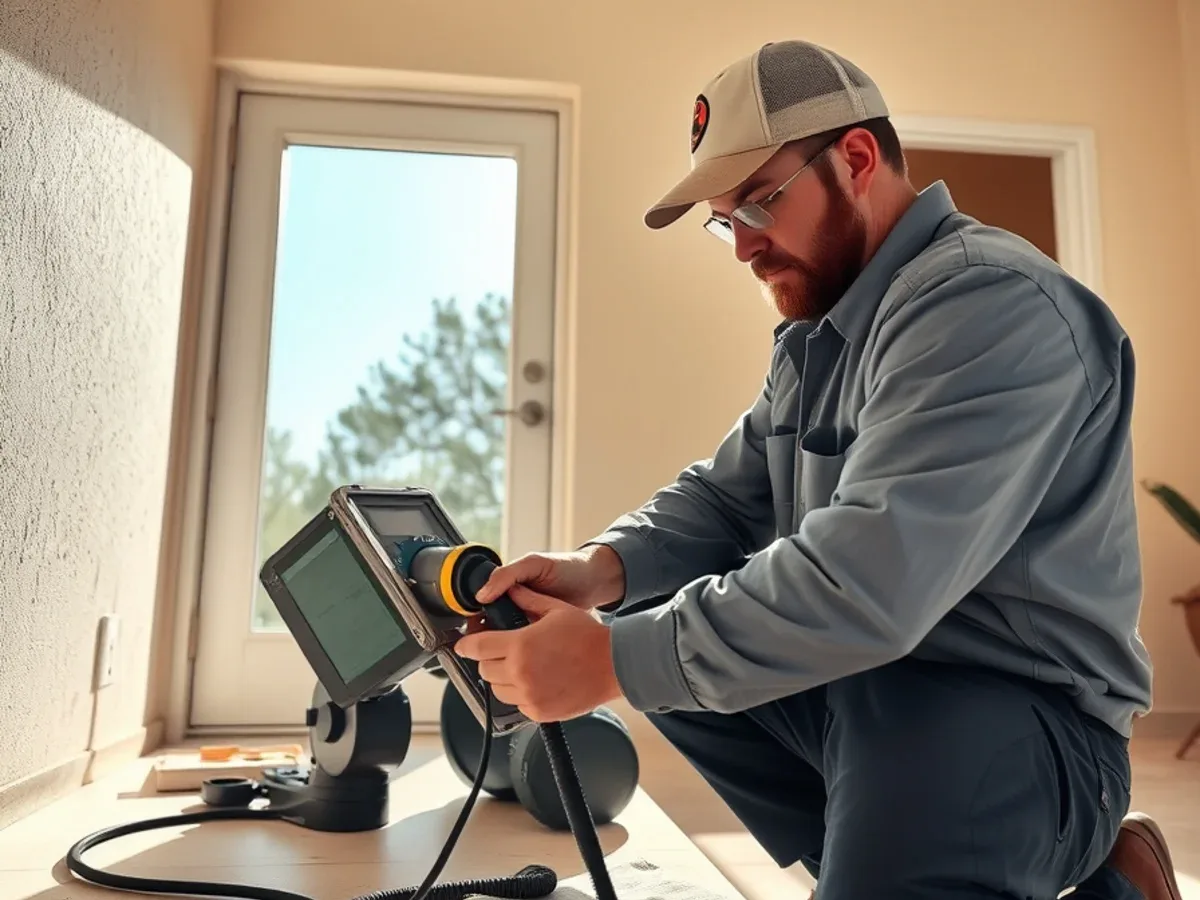
Isolation & meter testing
Confirms a leak exists, quantifies it, and separates supply-side from drain-side.
Line tracing
Maps the actual route and depth of the pipe under the slab.
Acoustic detection
Pinpoints the escape point by sound. The primary tool on most residential slab leaks.
Thermal imaging
Confirms hot-side leaks and shows how far moisture has already traveled.
Spot repair, reroute, or repipe — choosing honestly
Once we know where it is, there are three legitimate paths, and the right one depends less on this leak than on the condition of the rest of your plumbing.
A spot repair means opening the floor at the leak, cutting out the failed section and splicing in new pipe. It is the cheapest option and it makes sense when the system is otherwise healthy and this looks like an isolated failure — a piece of pipe that got a bad spot in the slab.
A reroute abandons the under-slab section entirely and runs a new line overhead through the attic and down through walls. It costs more than a spot repair, requires drywall work, and it means that particular run will never leak under concrete again. When a hot line has already failed once in a slab, a reroute is very often the smarter money.
A whole-home repipe is the answer when the leak is the third one, or when the house still has original polybutylene or heavily corroded galvanized. At that point you are not fixing a leak, you are ending a pattern. We will tell you which category you are in, and we will not pretend a spot repair is a permanent solution when we do not believe it is.
How a slab leak call runs
- 1
Confirm and quantify
Meter test with the house isolated to prove there is a leak and get a sense of how much water is being lost.
- 2
Narrow the field
Hot side or cold side, which branch, and whether it is under the slab at all — before anyone starts listening for it.
- 3
Pinpoint
Line tracing, acoustic detection and thermal imaging until we can mark the spot on your floor with confidence.
- 4
Present the options
Spot repair, reroute or repipe, each with a written price and a straight recommendation based on the age and material of your system.
- 5
Repair
Contained concrete cutting, the repair itself, pressure testing, and concrete restored properly rather than patched with a bag of quick-set.
- 6
Restore and document
We handle drywall and finish work in-house, and give you photos and a written scope for your insurance adjuster.
What drives the price
Leak detection is priced as its own step, because it is real diagnostic work with real equipment — and because you deserve to know where the leak is before you commit to a repair. The repair is quoted separately once we know what we are dealing with.
- How hard it is to find
- A hot line under open tile is straightforward. A cold line under a kitchen island with three appliances over it is not.
- What is on top of the slab
- Cutting through carpet is easy. Cutting through natural stone, custom tile or a finished garage floor adds restoration cost.
- Which repair you choose
- Spot repair is the lowest cost, reroute is the middle, repipe is the highest and eliminates the underlying problem completely.
- How long it has been leaking
- A leak found early is a plumbing job. A leak that has been soaking subfloor and drywall for six months brings remediation into the picture.
- Restoration
- Concrete, flooring and drywall are quoted as their own line items. We do our own drywall and finish work, which keeps it from becoming a second contractor.
Every quote is written, and the number does not change afterward. AZ ROC CR-37 Plumbing · BBB A+ accredited.
Why AllStar Home Services for slab leak repair
We tell you when it is a pattern, not an event
A first slab leak in a 1980s house with original copper is rarely the last. We will say so rather than quietly doing a fourth patch.
We put the wall back ourselves
Drywall Repair is one of the categories BBB accredits us under. Patching, texturing and blending is in the quote, not a referral to somebody else.
The quote is the price
You hear the number before we start and it does not move afterward. It is the single thing customers mention most in our reviews.
16+ years in the trade, 60+ across the team
Shane is a master plumber who still writes the estimates and runs calls — which means more repairs and fewer replacements.
Where we provide slab leak repair
Nearly every home in this region is slab-on-grade, so this service runs everywhere we work. We work this service across Apache Junction and Gold Canyon from our 15th Ave shop, then out through Queen Creek, San Tan Valley, Mesa, Gilbert, Chandler, Tempe and Fountain Hills. The heaviest concentration is in 1980s and 90s housing — Desert Harbor and Sonoma Valley in Apache Junction, east Mesa, Superstition Springs and older Chandler.
Further out we cover Florence, Coolidge, Casa Grande, Maricopa, Eloy, Superior and Mammoth, and we will tell you honestly when a small job does not justify the drive. We provide photographs, thermal images, the marked location and a written scope as standard, because that documentation is usually what determines whether an insurance claim succeeds.
- Slab Leak Repair in Apache Junction
- Slab Leak Repair in Gold Canyon
- Slab Leak Repair in Queen Creek
- Slab Leak Repair in Mesa
- Slab Leak Repair in Superstition Mountain
- Slab Leak Repair in Ironwood Estates
Slab Leak Repair questions, answered
Related reading
 Leaks
LeaksHow to Spot a Slab Leak Early
Almost every slab leak gives warning for weeks or months before anyone notices. Here are the signals, in the order they usually appear, plus a two-minute meter test that settles it.
6 min read Troubleshooting
Low Water Pressure in an Arizona Home: 7 Causes
The first question is whether it is one fixture or the whole house — because those are completely different problems with completely different price tags. Here is how to work it out.
7 min read