
Short answer
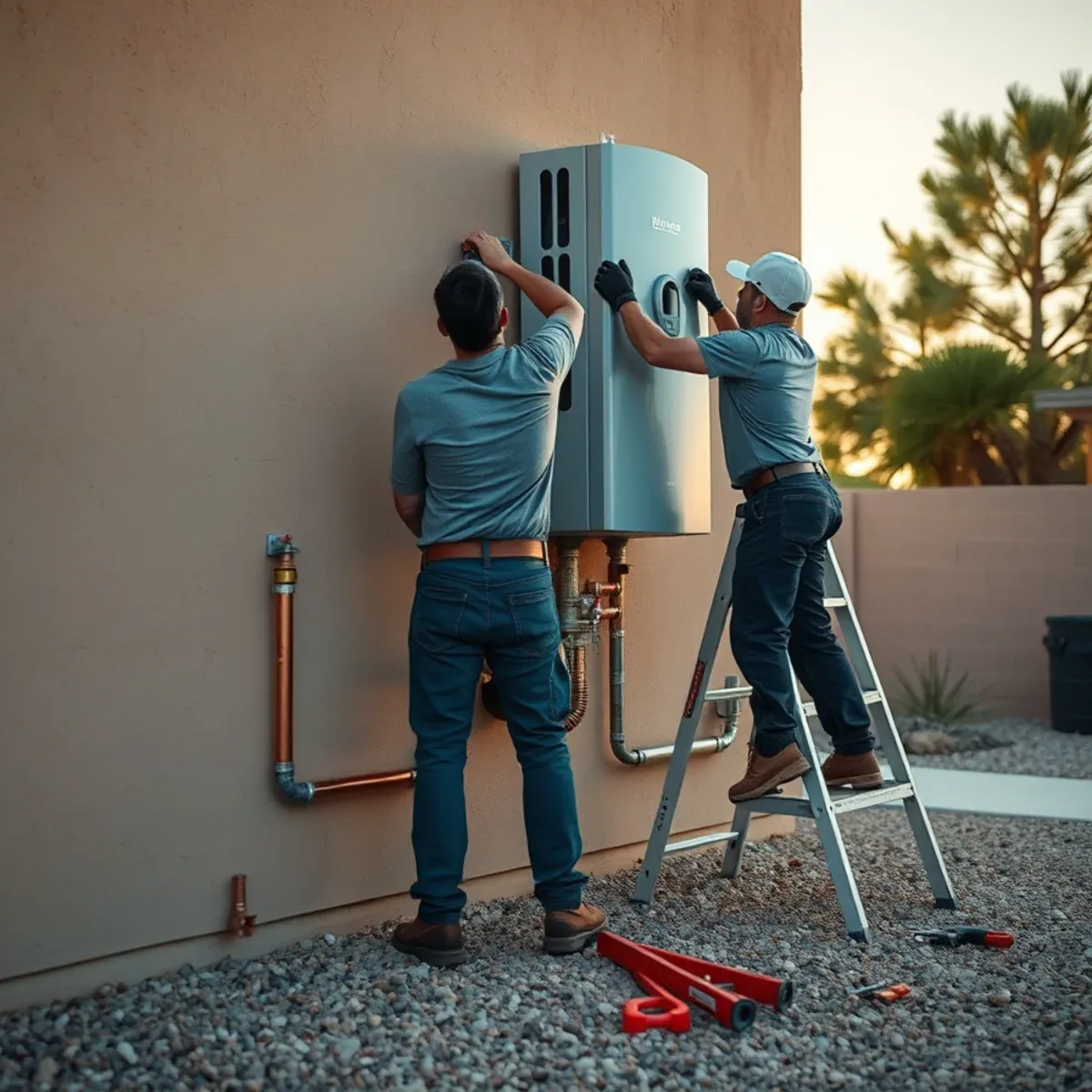
Tankless water heater installation in Apache Junction works well, but only with two things checked first: whether your gas line can actually feed a 150,000–199,000 BTU burner, and how you are going to keep 15–25 grain water out of the heat exchanger. Skip either and the unit fails years early, often outside warranty.
Tankless water heaters are a genuinely good upgrade for Apache Junction homes, and they are also the piece of equipment most commonly ruined by our water. Both things are true, and which one you end up with depends almost entirely on how the unit was installed.
A tankless heater works by pushing water through a compact heat exchanger and firing a very large burner only when you open a tap. There is no 50-gallon tank sitting in the garage losing heat all day, no reservoir to run out mid-shower, and no tank to eventually rust through and flood the floor. Properly maintained, a tankless unit commonly runs twenty years — roughly two and a half tanks.
The catch is that the same narrow, superheated passages that make it efficient are the perfect place for calcium to plate out. At 15 to 25 grains per gallon, an unprotected tankless heat exchanger in this town can foul badly in a handful of years. We install these units all the time, and we do not install one without solving the water first.
Thinking about going tankless?
We will test your water, check your gas line, and give you an itemized quote — free, and with no pressure to buy the bigger unit.
Signs a tankless upgrade is worth looking at
You keep running out of hot water
Back-to-back showers, a soaking tub, or laundry running at the same time. A correctly sized tankless unit simply does not run out.
Your tank is at end of life anyway
If you are replacing a ten-year-old heater regardless, that is the cheapest moment to convert — you are already paying for the labor of a removal.
You want the garage floor back
A tankless unit is roughly the size of a carry-on suitcase, mounted on the wall. In a two-car garage that is already tight, that is real space.
The house sits empty part of the year
Snowbird households pay to keep 50 gallons hot for months nobody is home. Tankless heats nothing until someone opens a tap.
You are remodeling anyway
If walls are open and gas or electrical is being touched, the venting and gas-line work a conversion needs gets dramatically cheaper.
You already have a softener
Softened water removes the single biggest objection to tankless in Arizona. If you have already solved the water, the case gets easy.
What a tankless water heaters job includes
Every quote covers the items below. If something is not on this list, it is not in the price — and we will say so before we start.
Gas load calculation
Total BTU demand, developed length including fittings, and confirmation the meter can carry it — measured at the estimate, not discovered mid-install.
On-site water hardness test
Free with the visit, so pretreatment is designed around your actual number rather than a citywide average.
Pretreatment specified and installed
A softener or a dedicated scale-prevention filter on the cold inlet. We do not install a tankless unit without it.
Isolation valves with service ports
Fitted as standard so the annual descale stays a one-hour maintenance visit instead of a teardown every year.
Sealed venting and condensate handling
Correct vent routing and a condensate drain with a neutraliser where the unit requires one.
Commissioning under full fire
Gas pressure verified at full load, temperature set, lines purged and delivered flow rate confirmed against the design figure.
The pretreatment conversation, before the equipment conversation
Every manufacturer that sells tankless heaters publishes a maximum water hardness in their installation manual, and Apache Junction water clears it by a wide margin — often by double. Ignoring that does not void physics, and in many cases it also voids the heat exchanger warranty.
There are three legitimate ways to handle it. A whole-home softener is the strongest option, because it protects the tankless unit and everything else in the house at the same time. A dedicated scale-prevention filter on the cold inlet is a smaller, cheaper option that treats the heater alone. And on some units, template-assisted crystallization media can convert hardness minerals into a form that stays suspended instead of plating out.
Whichever route you take, the unit also needs periodic descaling — an hour of circulating a descaling solution through the exchanger. We install isolation valves with service ports on every tankless job specifically so this is a simple annual task and not a disassembly.
Whole-home softener
Best protection, and it also saves the fixtures, the dishwasher and the washing machine. Our default recommendation.
Inline scale filter
Lower cost, protects the heater only, requires cartridge changes. A reasonable fit when a softener is not practical.
Isolation valve kit
Non-negotiable on our installs. Without service ports, annual descaling turns into a labor job every single year.
Annual descale
One hour, once a year. This is the maintenance item that decides whether you get twenty years or eight.
What a conversion actually involves
Swapping a tank for a tankless unit is not a like-for-like exchange, and any quote that treats it as one is missing something. A gas tankless heater fires at 150,000 to 199,000 BTU compared with roughly 40,000 for a typical tank, so the existing gas line is very often undersized. That means either upsizing the run from the meter or confirming the meter itself can carry the load.
Venting changes too. Tank heaters usually vent through an existing B-vent flue; a modern condensing tankless unit vents through sealed PVC or stainless steel, typically out a side wall, and it produces acidic condensate that has to be drained and often neutralized.
Electric tankless is a different set of problems in a house not built for it — whole-home electric units commonly need multiple dedicated 40-amp circuits and a panel with room to spare. In most Apache Junction homes, gas is the practical answer. We will tell you at the estimate which of these apply to your house, in writing, before you commit to anything.
Is it worth the money?
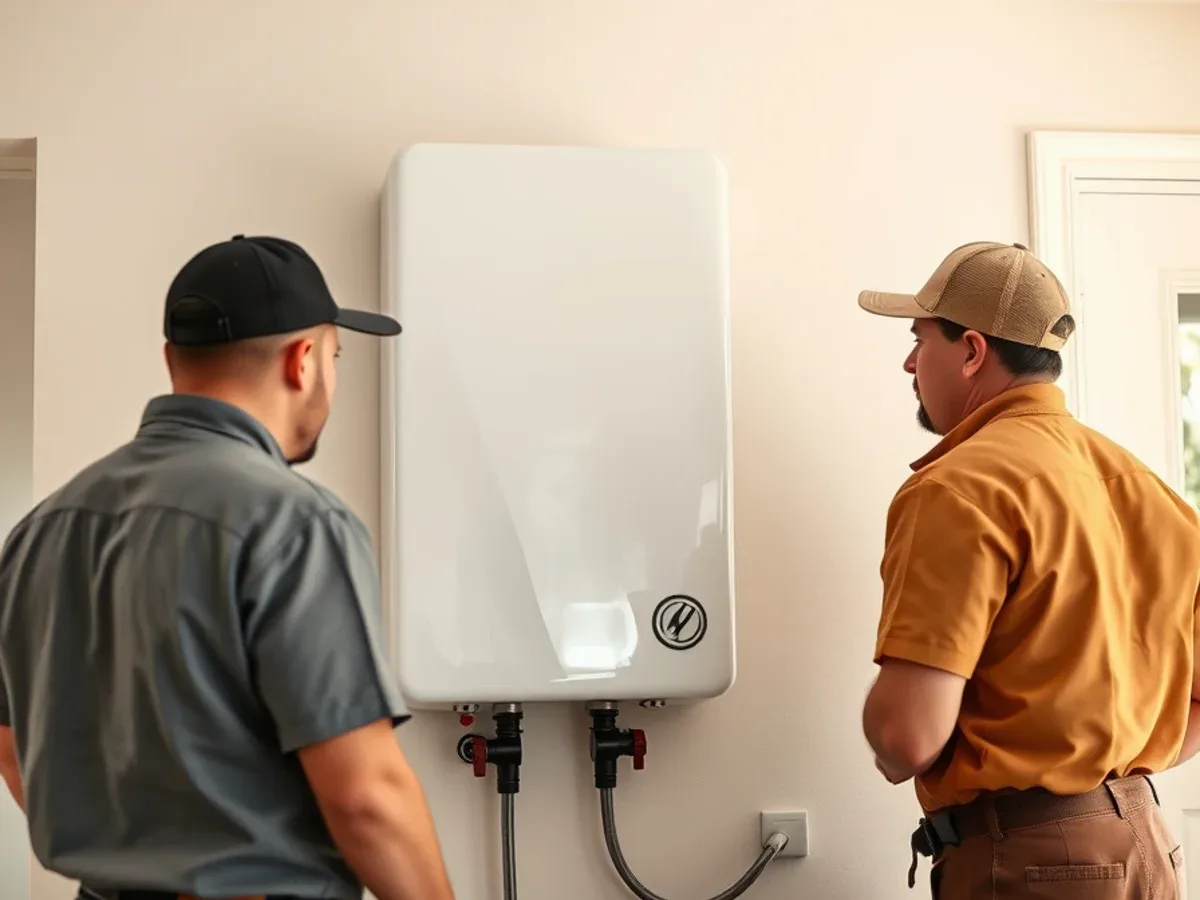
Honestly, it depends on why you want it. If the goal is a fast energy payback, a tankless conversion is a slow return — you save the standby losses of keeping a tank hot, which is real but modest, and the up-front cost of a conversion is meaningfully higher than a tank swap.
If the goal is never running out of hot water, reclaiming floor space, cutting the risk of a tank flooding your garage, and buying equipment that should outlast two replacement tanks, the case is strong. It gets stronger for households that are away for months, and stronger again if you are already installing a softener.
What we will not do is pitch you a tankless unit because it has a bigger ticket. If a straight tank replacement is the right call for your house and your budget, we will say so.
How a tankless install runs
- 1
Load and gas assessment
We calculate your peak flow demand in gallons per minute, check incoming water temperature, and measure the existing gas line and meter capacity.
- 2
Water test
We test hardness on site and design the pretreatment around the actual number, not an assumption.
- 3
Written scope
Unit, pretreatment, gas work, venting, condensate handling and permit — all itemized before you approve it.
- 4
Permitted installation
Gas sizing, sealed venting, condensate drain and neutralizer where required, isolation valves with service ports, and a proper mounting location.
- 5
Commissioning
We set the temperature, verify gas pressure under full fire, purge the lines, and confirm the delivered flow rate matches the design.
- 6
Maintenance handoff
We show you the service ports, explain the descaling interval, and put you on a reminder so it actually happens.
What drives the price
Tankless quotes are free and itemized. There is a real range here, and it is driven mostly by what your house already has rather than by the unit you pick.
- Gas line and meter capacity
- If the existing 1/2" run cannot feed a 199,000 BTU burner, it gets upsized. This is frequently the largest single line item in a conversion.
- Venting route
- A short side-wall vent through a garage wall is inexpensive. Routing sealed vent through finished ceiling or a long run to an exterior wall is not.
- Condensing vs non-condensing
- Condensing units are more efficient and use cheaper PVC venting, but add a condensate drain and sometimes a neutralizer. Usually the better total-cost answer.
- Pretreatment scope
- A whole-home softener costs more than an inline scale filter and protects far more of the house. Both beat installing nothing.
- Recirculation
- If you want hot water fast at a far bathroom, a recirculation pump and either a dedicated return line or a crossover valve adds cost and adds a lot of daily satisfaction.
Every quote is written, and the number does not change afterward. AZ ROC CR-37 Plumbing · BBB A+ accredited.
Why AllStar Home Services for tankless water heaters
We will tell you when a tank is the better buy
If your gas line is undersized, the house is electric-only or you are moving soon, we will say so. A tankless unit carries a bigger ticket and that is not a reason to sell you one.
The quote is the price
You hear the number before we start and it does not move afterward. It is the single thing customers mention most in our reviews, and it is a deliberate policy.
Licensed, insured and permitted
Arizona ROC classification CR-37, issued November 2024, and BBB accredited with an A+ rating. We pull permits and pass the fee through at cost.
4.7★ from 20 verified Google reviews
We publish every review we have — including the two critical ones. A page of nothing but five stars tells you less than an honest one.
Where we provide tankless water heaters
Tankless conversions come up most in the newer construction around Queen Creek, San Tan Valley, Gilbert and the Apache Junction subdivisions built after 2000, and in the larger foothill homes toward Superstition Mountain and Gold Canyon where long runs make endless hot water genuinely worth it. We deliver this service from our shop on 15th Ave across Apache Junction and Gold Canyon — usually within ten to fifteen minutes — and out through Queen Creek, San Tan Valley, Mesa, Gilbert, Chandler, Tempe and Fountain Hills.
Further out we cover Florence, Coolidge, Casa Grande, Maricopa, Eloy, Superior and Mammoth. For the outer edges of Pinal County we are honest about when a small repair does not justify the drive, and when a larger job absolutely does. Wherever you are, the gas sizing and the water treatment are the two things that decide whether the unit lasts twenty years or eight.
- Tankless Water Heaters in Apache Junction
- Tankless Water Heaters in Gold Canyon
- Tankless Water Heaters in Queen Creek
- Tankless Water Heaters in Mesa
- Tankless Water Heaters in Superstition Mountain
- Tankless Water Heaters in Ironwood Estates
Tankless Water Heaters questions, answered
Related reading
 Water Heaters
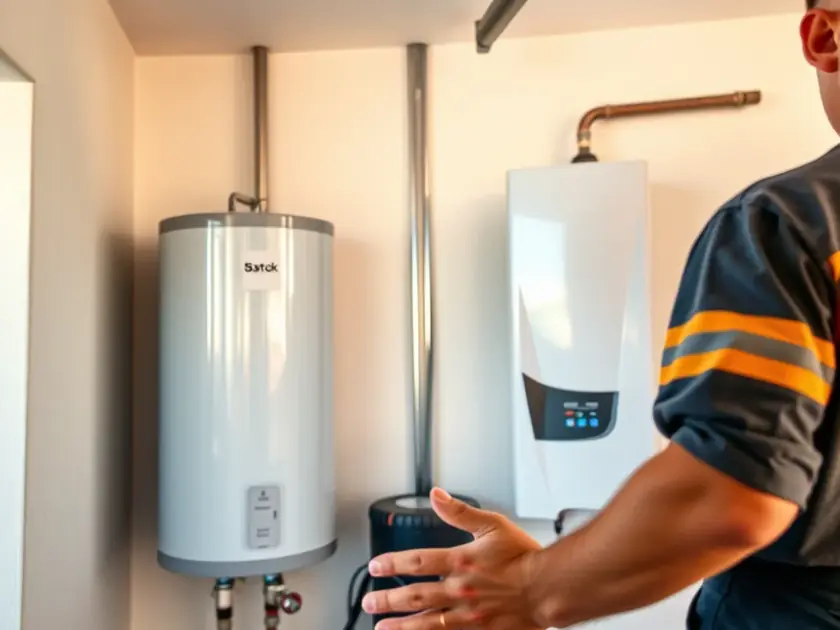
Tankless vs Tank Water Heaters in Arizona
Tankless is genuinely better in several ways and a worse decision in a few specific situations. Here is the honest comparison, including the gas line question that catches most people out.
8 min read Hard Water
How Hard Water in Apache Junction Destroys Your Plumbing
At 15 to 25 grains per gallon, Apache Junction has some of the hardest water in the country. Here is what that mineral is actually doing inside your pipes, your water heater and your fixtures — and the maintenance that changes the outcome.
7 min read