
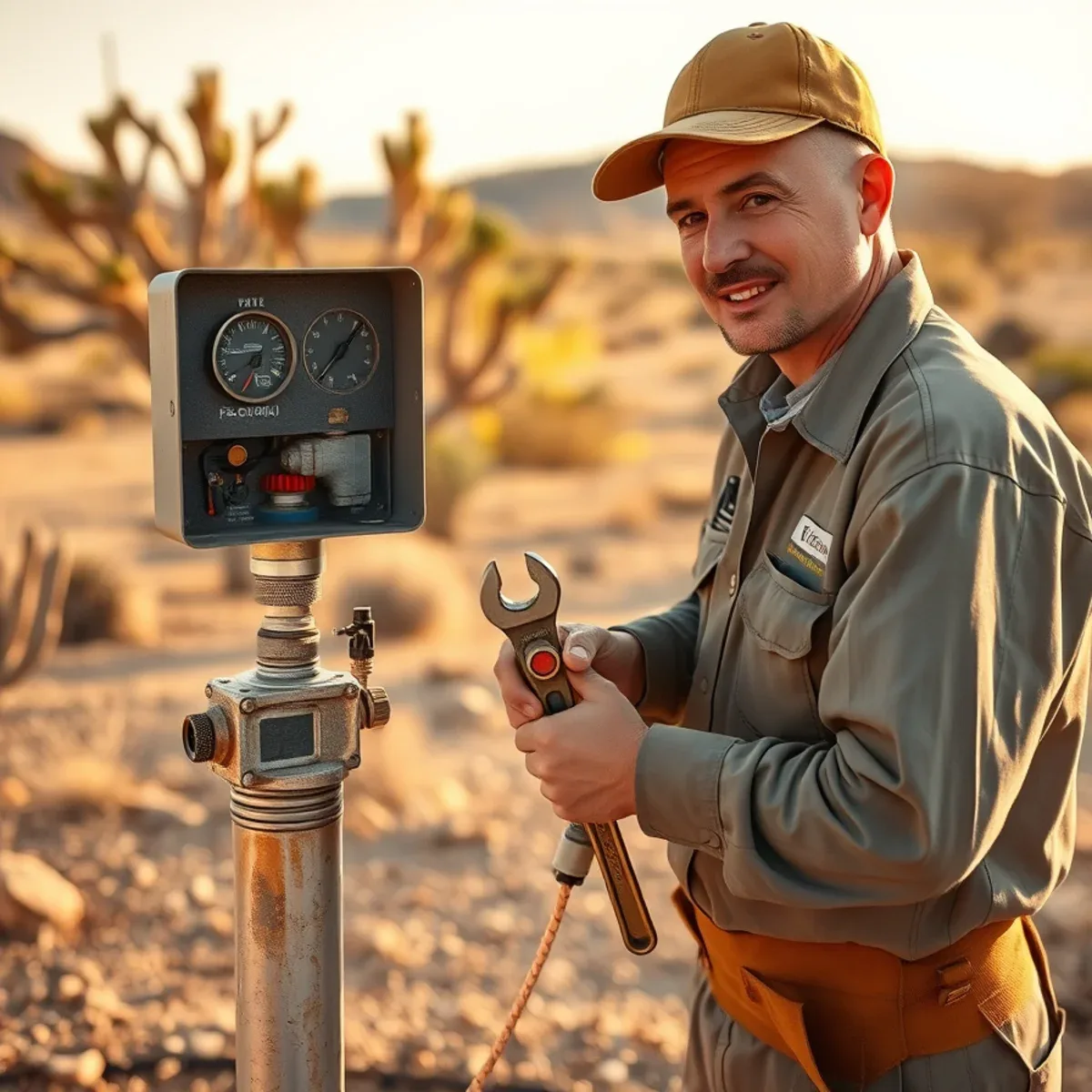
Short answer
On a private well you are the utility, and the single most common diagnosis we make is a waterlogged pressure tank being mistaken for a failing pump. The tank is dramatically cheaper to replace — and left alone, the short-cycling it causes is what actually destroys the pump.
Plenty of properties around Apache Junction are not on city water. Out toward Goldfield, across much of Gold Canyon, and through the rural stretches of Pinal County, the water comes from a private well — which means you are the utility. Nobody else is monitoring your water quality, maintaining your pump, or noticing when your pressure tank fails.
This is a category most plumbing companies in the East Valley quietly avoid. Well systems require different diagnostics, different equipment, and a real understanding of local groundwater chemistry. We work on them, and we start by understanding what is actually in your water rather than selling a package.
We service submersible and jet pumps, replace pressure tanks and switches, chase down pressure and cycling problems, and design filtration and softening for the specific chemistry a well produces — which in this region usually means iron, sometimes manganese, often hydrogen sulfide, and sediment that changes with the seasons.
On a well? We actually work on them.
Pumps, pressure tanks and treatment designed around a real water test — not a package off a shelf.
Signs your well system needs attention
The pump cycles rapidly on and off
Short-cycling almost always means a waterlogged pressure tank that has lost its air charge. Left alone it destroys the pump.
Pressure that surges and drops
Pressure switch, tank charge, or a failing pump. All diagnosable, and all worth catching before the pump goes.
Sputtering air at the taps
Air in the lines can mean a dropping water table, a leak in the drop pipe, or a pump drawing at its limit.
Orange or brown staining
Iron. It stains fixtures and laundry permanently and it will ruin softener resin if it is not removed first.
Rotten-egg smell
Hydrogen sulfide, sometimes with sulfur bacteria. Unpleasant, and corrosive to plumbing components over time.
Cloudy water or grit in aerators
Sediment, frequently worse after monsoon rain recharges the aquifer. It wears pump components and clogs fixtures.
What a well pumps & well water job includes
Every quote covers the items below. If something is not on this list, it is not in the price — and we will say so before we start.
Pressure tank checked first
Air charge, bladder integrity and cut-in/cut-out pressures. The cheapest failure gets ruled out before anyone talks about pulling a pump.
System measured, not guessed
Static and dynamic pressure, draw-down, recovery time and amp draw on the pump to see whether it is working harder than it should.
Water tested properly
Hardness on site, plus a recommended lab panel for iron, manganese, sulfide, nitrate and bacteria before any treatment is designed.
Treatment designed in the correct sequence
Sediment, then iron and sulfur removal, then softening, then polishing. Putting a softener first is what permanently destroys resin beds.
Pump, tank and controls
Replacement pumps, pressure tanks, switches and wiring, with bypasses fitted so future service does not mean draining everything.
Commissioned and documented
Pressures set, system flushed, treatment programmed, and a written record of what your water tested at before and after.
The pressure tank is usually the problem
When homeowners call about a failing well pump, the culprit is a waterlogged pressure tank more often than the pump itself — and that is good news, because a tank is far less expensive than pulling a submersible pump out of a deep well.
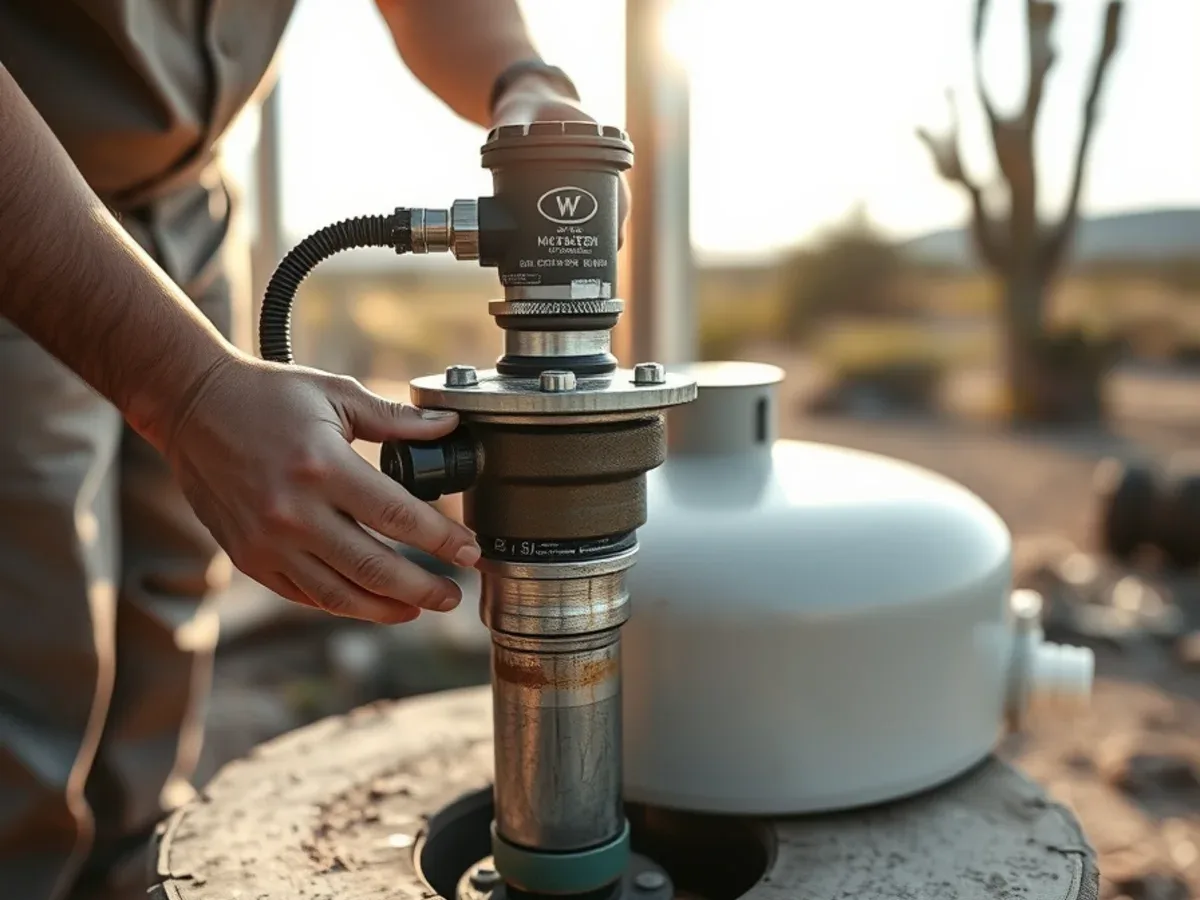
A pressure tank holds a cushion of compressed air separated from the water by a bladder. That cushion is what lets you draw water without the pump starting every time. When the bladder fails or the air charge bleeds off, there is no cushion left, and the pump kicks on and off every few seconds any time water runs. That short-cycling is brutal on a pump motor — it is the single fastest way to destroy one.
Checking it is simple. Turn off power to the pump, drain the system, and check the air pressure at the schrader valve on top of the tank. It should read about 2 psi below the pump cut-in pressure. If water comes out of that valve instead of air, the bladder has ruptured and the tank needs replacing. We check this on every well call before anyone starts talking about pumps.
Designing treatment for what your well actually produces
Well water in this part of Pinal County is not just harder city water. It commonly carries dissolved iron, sometimes manganese, frequently hydrogen sulfide, and a sediment load that varies through the year and spikes after heavy monsoon recharge. Each of those needs a different stage, and the order matters enormously.
Iron is the one that costs people money. Dissolved ferrous iron is invisible coming out of the tap and oxidizes to rust-orange in the fixture, which is why toilet tanks and shower corners stain. If you run that water into a standard softener, the iron fouls the resin bed and the unit permanently loses capacity — we see softeners killed this way constantly on well properties.
The correct sequence is sediment filtration first to protect everything downstream, then oxidation and iron and sulfur removal, then softening for hardness, then any point-of-use polishing like reverse osmosis for drinking water. UV disinfection goes at the end if bacteria are present. Build it in the wrong order and you will replace equipment early.
Stage 1 — Sediment
Spin-down or cartridge filtration sized for your sediment load. Protects everything downstream.
Stage 2 — Iron & sulfur
Oxidizing filter media that converts dissolved iron and hydrogen sulfide into filterable particles.
Stage 3 — Softening
Ion exchange for hardness, installed after iron removal so the resin bed survives.
Stage 4 — Polish
Carbon, UV disinfection where bacteria are present, and under-sink reverse osmosis for drinking water.
Testing, and why once a year is the right interval
Nobody tests your well but you. City systems are sampled continuously and reported publicly; a private well is entirely on the owner. Arizona guidance for private wells is to test annually for total coliform bacteria and nitrate at minimum, and to add iron, manganese, sulfate, arsenic, TDS and pH when you are designing treatment or when the water changes.
Timing matters here. Well chemistry in this region genuinely shifts with the seasons and with monsoon recharge — a well that tested clean in April can pick up surface influence after a heavy August storm, especially if the wellhead seal or casing has any compromise. If your water changes taste, color or smell noticeably after a storm, that is a reason to test rather than wait.
We would rather send you for a proper lab panel than design a system off a test strip. Guessing at well chemistry produces equipment that does not work and money that does not come back.
How a well service call runs
- 1
Check the tank and switch first
Air charge, bladder integrity, cut-in and cut-out pressures. The cheapest failures get ruled out before the expensive ones.
- 2
Measure the system
Static and dynamic pressure, draw-down, recovery, and amp draw on the pump to see whether it is working harder than it should.
- 3
Test the water
Hardness on site, and a recommended lab panel for iron, manganese, sulfide, nitrate and bacteria where treatment is on the table.
- 4
Present the actual options
Repair the switch, replace the tank, replace the pump, or build treatment — each priced, with what we would do in your position.
- 5
Do the work
Pump and tank replacement, wiring and controls, and treatment installed in the correct sequence with bypasses for service.
- 6
Commission and document
Pressures set, system flushed, treatment programmed, and a written record of what your water tested at before and after.
What drives the price
Well work spans a very wide range, from a pressure switch to a full treatment train. Everything is quoted before it starts.
- What actually failed
- A pressure switch is minor. A pressure tank is moderate. Pulling and replacing a submersible pump is a major job.
- Well depth
- Depth determines how much drop pipe and wire has to come out and go back in, and what equipment is needed to do it.
- Water chemistry
- Hardness alone needs one unit. Iron plus sulfur plus sediment plus bacteria needs four stages and costs accordingly.
- Existing equipment condition
- Sometimes an existing softener can be reused behind new iron removal. Sometimes the resin is already fouled beyond saving.
- Access to the wellhead
- A clear, drivable wellhead is efficient. One behind landscaping, fencing or a long distance from the drive is not.
Every quote is written, and the number does not change afterward. AZ ROC CR-37 Plumbing · BBB A+ accredited.
Why AllStar Home Services for well pumps & well water
We actually work on wells
Most East Valley plumbing companies quietly avoid them. Well systems need different diagnostics and a real understanding of local groundwater, and we will send you for a lab panel rather than sell equipment on a guess.
The quote is the price
You hear the number before we start and it does not move afterward. It is the single thing customers mention most in our reviews.
16+ years in the trade, 60+ across the team
Shane is a master plumber who still writes the estimates and runs calls — which means more repairs and fewer replacements.
Based at 870 W 15th Ave, not a call centre
Shane, Leo and Justin live in Apache Junction. Most of the city is a ten to fifteen minute drive rather than a cross-valley dispatch.
Where we provide well pumps & well water
Well work concentrates outside municipal service. Gold Canyon, the Goldfield area, Tonto Forest Estates and the rural edges of Apache Junction are our densest well territory, and we reach most of it in ten to fifteen minutes.
Beyond that we cover well properties through Florence, Coolidge, Casa Grande, Maricopa, Eloy, Superior and out into the San Pedro Valley around Mammoth. For remote addresses, give us cross streets or a dropped pin when you call — plenty of Pinal County acreage does not map cleanly.
- Well Pumps & Well Water in Apache Junction
- Well Pumps & Well Water in Gold Canyon
- Well Pumps & Well Water in Queen Creek
- Well Pumps & Well Water in Mesa
- Well Pumps & Well Water in Superstition Mountain
- Well Pumps & Well Water in Ironwood Estates
Well Pumps & Well Water questions, answered
Related reading
 Well Water
Well Water Filtration for Gold Canyon & Rural Pinal County
Well water in Gold Canyon is not just harder city water. Iron, sulfur and sediment need to be dealt with in a specific order — and getting that order wrong destroys equipment.
8 min read Hard Water
Do You Need a Water Softener in Apache Junction?
Salt-based or salt-free? What size? Will it taste salty? A straight answer to every water softener question we get asked in Apache Junction, including when the honest answer is that you do not need one.
8 min read