
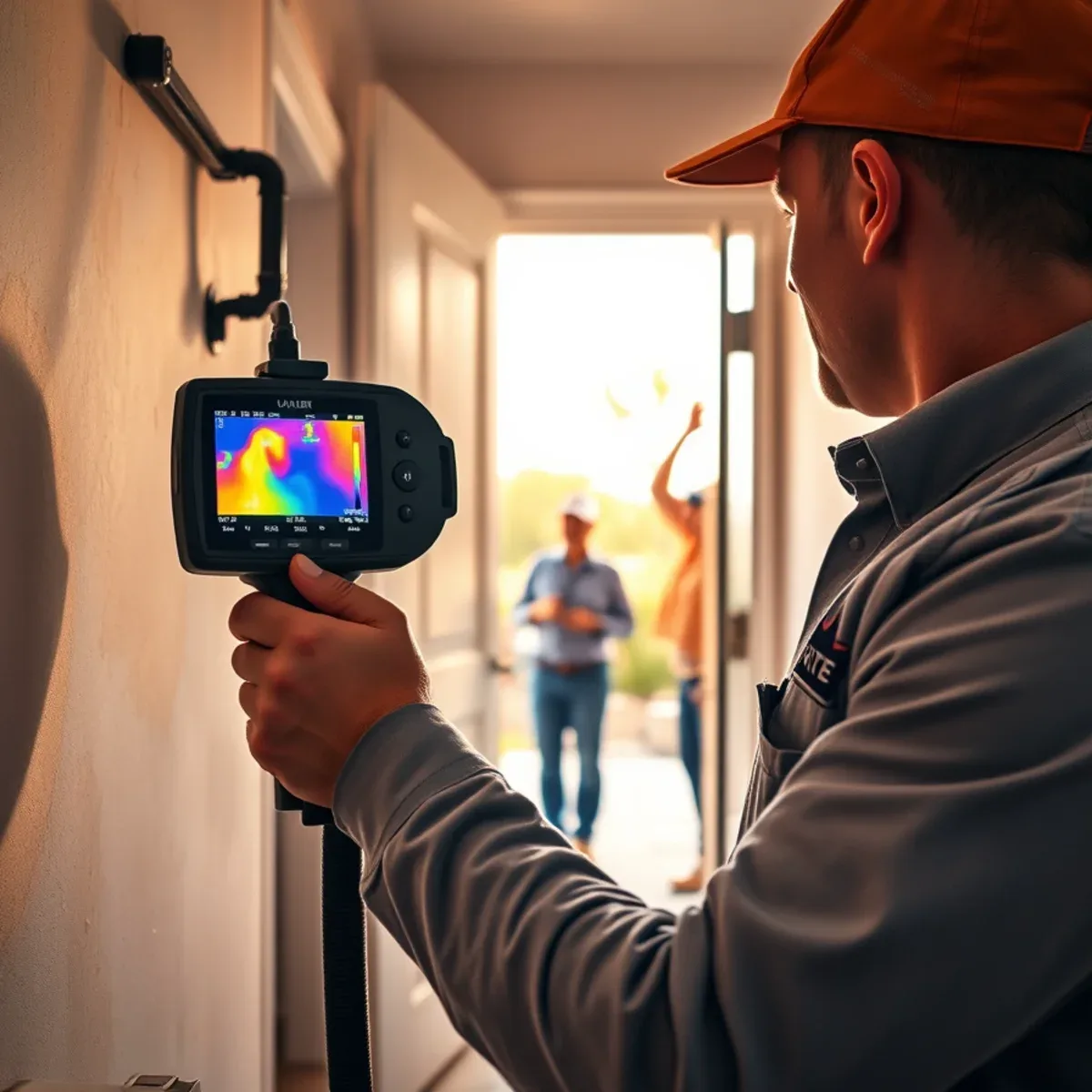
Short answer
Leak detection in Apache Junction is about precision, not discovery — any plumber can find a leak by opening enough wall or concrete. We price it as its own service so you get the marked location, photographs and a measured loss rate, and you are free to take that documentation anywhere.
Any plumber can find a leak eventually by opening enough wall, floor or concrete. Finding it within a foot, before anything is cut, is a completely different service — and it is the difference between a contained repair and a room you no longer recognise.
Leak detection is diagnosis, and we price it as its own step for a reason: you deserve to know exactly where the water is going before you commit to a repair, and you should be free to take that information anywhere.
We find leaks under slabs, behind walls, above ceilings, in irrigation and pool lines, and in the underground service line between the meter and the house. Different problems, same principle — measure first, cut once.
Water bill up with no explanation?
Run the meter test tonight. If the indicator moves with everything off, call us — we will find it before anything gets cut.
What tells you there is a leak somewhere
The water bill jumped and nothing changed
Usually the earliest signal. Compare against the same month last year, not last month, so irrigation season does not confuse it.
Running water in a silent house
Everything off, and you can still hear a faint hiss or trickle. That is water moving where it should not be.
A warm patch on the floor
Hot-side slab leak. Hot lines cycle most and abrade against concrete, so they fail first.
Pressure that dropped everywhere at once
A significant leak bleeds off system pressure. If nothing changed at the street, suspect a leak.
A green stripe across a dry yard
Irrigation or service line leak. In a gravel desert yard this is one of the most reliable tells there is.
Damp drywall, musty smell or lifting flooring
Water has been moving long enough to reach finishes. Act quickly — this is the expensive stage.
What a leak detection job includes
Every quote covers the items below. If something is not on this list, it is not in the price — and we will say so before we start.
Meter isolation test
Proves a leak exists, measures the loss rate, and separates an inside leak from one in the buried service line between meter and house.
Hot side or cold side determined
Isolating the water heater halves the search area in one test, before any specialist equipment comes out.
Line tracing
Maps where the pipe actually runs beneath a floor or inside a wall, which is frequently not where the fixture positions suggest.
Acoustic pinpointing
Amplifies the sound of water escaping under pressure. On a quiet slab this localises a leak to within about a foot.
Thermal imaging
Confirms hot-side leaks and shows how far moisture has already travelled through the structure — usually further than expected.
Documentation you keep
Marked location, photographs, thermal images and the timed loss rate, in the format an insurance adjuster actually needs.
The two-minute test you can do tonight
Before you call anyone, do this. Turn off every fixture and water-using appliance in the house — including the ice maker and the irrigation controller. Then go to your water meter and find the leak indicator: a small triangle, star or dial that spins with any flow at all.
If it is moving with everything off, water is escaping somewhere. That is not proof of a slab leak specifically, but it is proof of a leak, and it is the single most useful piece of information you can hand us.
To narrow it further, close the main shutoff valve at the house and watch again. If the indicator stops, the leak is inside the house. If it keeps moving, the leak is between the meter and the house — the underground service line, which is a different repair entirely.
Photograph the meter, wait an hour with everything off, photograph it again. That gives you a documented loss rate, which is useful for us and often decisive for an insurance adjuster.
How we actually find it
Detection is elimination, and each step narrows the search. We start by isolating: shut individual fixtures and branches, watch the meter, and determine whether the leak is on the pressurised supply side, whether it is hot or cold, and which branch it is on. That single sequence typically halves the search area twice over.
Then we trace. Line-tracing equipment maps where the pipe actually runs beneath a floor or inside a wall, which is frequently not where anyone assumes from looking at the fixtures.
Acoustic listening equipment amplifies the sound of pressurised water escaping through a small opening. On a quiet slab, a skilled operator can localise that sound remarkably tightly. Thermal imaging confirms hot-side leaks by showing the heat plume spreading through concrete or drywall, and it also shows how far moisture has already travelled — which is often further than anyone expects.
Where the picture is still ambiguous, we can isolate a line and pressurise it with inert tracer gas, then detect it at the surface. That is the tool for cold-side leaks that are not making enough noise to hear.
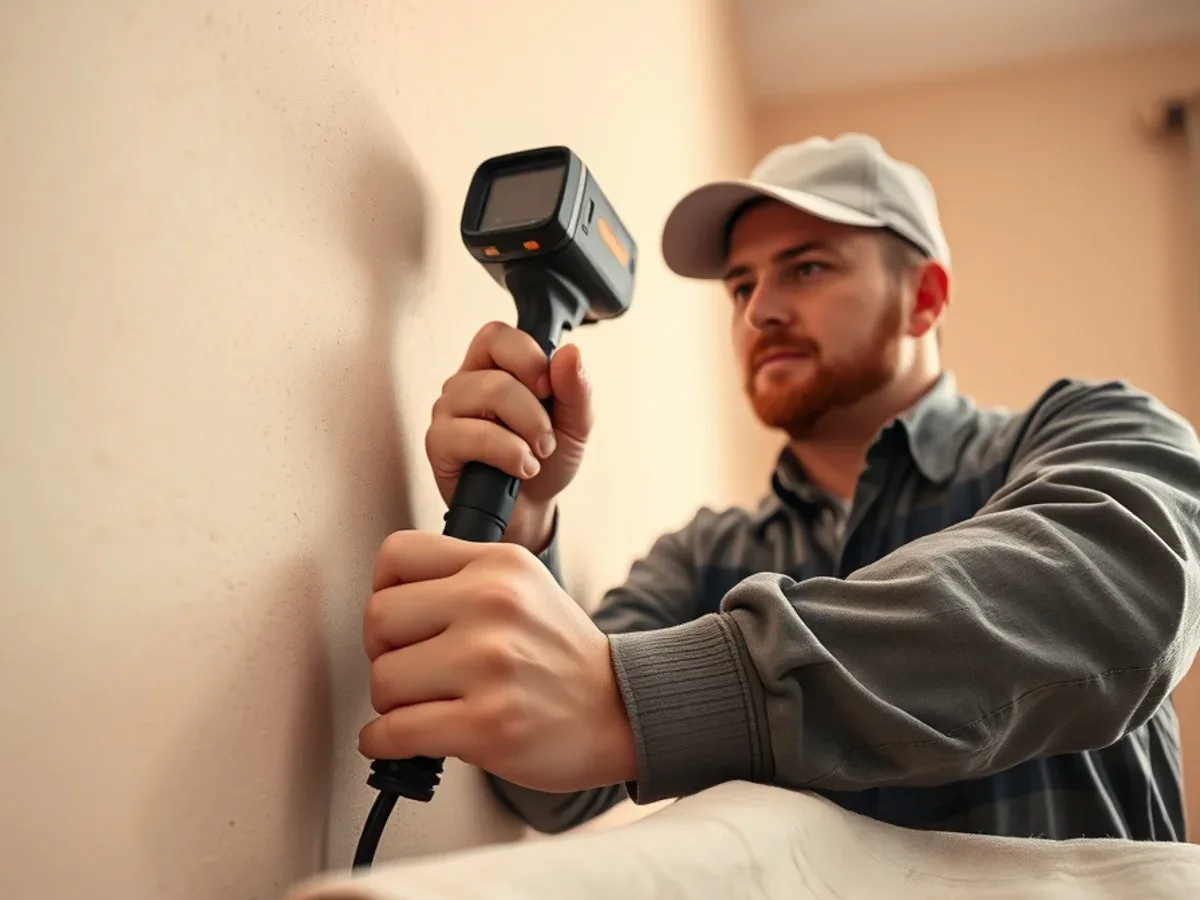
Meter isolation testing
Proves a leak exists, quantifies the loss rate, and separates inside from service line.
Line tracing
Maps the true route and depth of the pipe before anyone marks a floor.
Acoustic detection
Pinpoints the escape point by sound. The primary tool on most residential leaks.
Thermal imaging
Confirms hot-side leaks and reveals the extent of moisture already in the structure.
Leaks that are not in the house at all
A meaningful share of the leaks we chase in Apache Junction are outside the building envelope, and they get missed for months because there is nothing to see indoors.
Irrigation is the most common. Drip systems, valve manifolds and buried poly lines all fail, and in a gravel yard the water simply disappears into the soil. The tell is a patch that is suspiciously green, or a control valve box that is always damp.
Pool and spa lines are the next. A pool losing more than roughly a quarter-inch a day beyond normal evaporation — and evaporation here is significant in summer — is worth investigating. We can isolate the plumbing from the shell to work out which one you have.
And the service line between the meter and the house is genuinely common on older properties. That run is the homeowner's responsibility in almost every case, which surprises people, and it is exactly why the meter test matters so much.
How a detection call runs
- 1
Confirm and quantify
Meter test with the house isolated, so we start from a measured loss rate rather than a hunch.
- 2
Narrow the field
Supply or drain, hot or cold, inside or service line, which branch — all determined before anyone starts listening.
- 3
Trace the actual pipe route
Mapping where the line really runs, which is regularly not where the fixtures suggest.
- 4
Pinpoint
Acoustic, thermal and where needed tracer gas, until we can mark the spot with confidence.
- 5
Show you what we found
Marked location, photos, thermal images and the measured loss rate — documentation you can hand an adjuster.
- 6
Repair options, priced separately
You are never obliged to have us do the repair. The detection stands on its own.
What drives the price
Leak detection is quoted as its own service because it is real diagnostic work with real equipment. The repair, if you want one, is quoted separately once we know what we are dealing with.
- How hard it is to find
- A hot line under open tile is straightforward. A cold-side leak under a kitchen island with three appliances above it is not.
- How much has to be isolated
- Homes with accessible shutoffs at each branch test quickly. Systems with no isolation valves take considerably longer.
- Which equipment the job needs
- Acoustic and thermal cover most residential leaks. Tracer gas is an additional step reserved for the genuinely stubborn ones.
- Inside, irrigation or pool
- Three different search methods. Pool and irrigation work often means isolating and pressure-testing individual zones.
- Documentation
- Photos, thermal images and a written loss rate for an insurance claim are included — that paperwork is often what makes a claim succeed.
Every quote is written, and the number does not change afterward. AZ ROC CR-37 Plumbing · BBB A+ accredited.
Why AllStar Home Services for leak detection
You are not locked into the repair
Detection stands alone. Most customers do have us do the repair, and that should be because the quote was fair rather than because you had no choice.
The quote is the price
You hear the number before we start and it does not move afterward. It is the single thing customers mention most in our reviews.
16+ years in the trade, 60+ across the team
Shane is a master plumber who still writes the estimates and runs calls — which means more repairs and fewer replacements.
4.7★ from 20 verified Google reviews
We publish every review including the two critical ones. A page of nothing but five stars tells you less than an honest one.
Where we provide leak detection
Detection work runs across the whole area, and a meaningful share of it is outside the building envelope entirely. We deliver this from our 15th Ave shop across Apache Junction and Gold Canyon, then out through Queen Creek, San Tan Valley, Mesa, Gilbert, Chandler, Tempe and Fountain Hills.
Further out we cover Florence, Coolidge, Casa Grande, Maricopa, Eloy, Superior and Mammoth, and we are honest about when a small job does not justify the drive. On the larger lots through Gold Canyon, Tonto Forest Estates, Fountain Hills and rural Pinal County, irrigation leaks and buried service-line failures are the most common find — in a gravel yard the water simply disappears into the soil and the only symptom is the bill.
- Leak Detection in Apache Junction
- Leak Detection in Gold Canyon
- Leak Detection in Queen Creek
- Leak Detection in Mesa
- Leak Detection in Superstition Mountain
- Leak Detection in Ironwood Estates
Leak Detection questions, answered
Related reading
 Leaks
LeaksWhat Happens During a Professional Leak Detection
People are wary of paying for something they cannot see happening. Here is exactly what the process involves, what each tool does, and what you should walk away with.
7 min read Leaks
LeaksHow to Spot a Slab Leak Early
Almost every slab leak gives warning for weeks or months before anyone notices. Here are the signals, in the order they usually appear, plus a two-minute meter test that settles it.
6 min read