
Short answer
Water softener installation in Apache Junction is the highest-return plumbing purchase available here, because local supply tests 15–25 grains per gallon against a 'very hard' threshold of 10.5. The unit has to be sized from your measured hardness, household size and actual daily use — not from square footage.
Apache Junction has some of the hardest water in the United States. Local supply typically tests between 15 and 25 grains per gallon, and the Water Quality Association classifies anything above 10.5 as very hard. That number is not trivia — it is the reason water heaters here die early, faucet cartridges fail, dishwashers leave film, showerheads clog, and skin and hair feel the way they do after a shower.
Every gallon that enters your house carries dissolved calcium and magnesium. When that water is heated or evaporates, the minerals come out of solution and stick to whatever they were touching. Inside a water heater that becomes an insulating crust on the tank floor. Inside a tankless heat exchanger it becomes a restriction. Inside your fixtures it becomes the reason a faucet that should last fifteen years starts dripping at four.
We size, install and service salt-based softeners, salt-free conditioners, whole-home carbon filtration, iron removal for well properties, and under-sink reverse osmosis for drinking water. And we start every one of them the same way: by testing your water rather than assuming.
Find out what your water actually tests at.
Free on-site hardness test with any service call — and a straight recommendation, including "you do not need this."
What untreated hard water is doing at your house
White crust on faucets and showerheads
That is the same deposit forming inside pipes, valves and your water heater where you cannot see it.
Spots on glasses out of the dishwasher
Mineral left behind as water evaporates. No amount of rinse aid fixes water this hard.
Soap and shampoo that will not lather
Calcium binds with soap instead of foaming. You use more product and it still feels like it did not rinse off.
Stiff, scratchy laundry
Mineral deposits in fabric fibers. Softened water noticeably extends the life of clothing and linens.
A water heater that rumbles
Sediment on the tank floor boiling water underneath it. Direct, audible evidence of what hard water is costing you.
Appliances failing early
Dishwashers, washing machines, ice makers and coffee equipment all scale internally. Some manufacturers limit warranty coverage on water this hard.
What a water softeners job includes
Every quote covers the items below. If something is not on this list, it is not in the price — and we will say so before we start.
Hardness tested at your tap
Free with any service call. Sizing from a real number rather than a citywide average is the whole difference between a softener that works and one that does not.
Grain capacity calculated, not guessed
Hardness × people × daily usage. A correctly sized system regenerates every three to seven days rather than every night.
Metered demand-initiated regeneration
It regenerates when you have actually used the capacity, not on a timer regardless. For part-year households that difference is enormous in salt and water.
Correct position in the line
After the main shutoff and pressure regulator, before the water heater, with a bypass valve so the system can be isolated for service.
Drain with a proper air gap
To code, so there is no backflow path. Exterior hose bibs are left on untreated water — no reason to soften what goes on gravel.
Commissioning and a post-install test
Resin conditioned, head programmed to your hardness and usage, and output tested so you can see the before-and-after number.
Softener, conditioner, or filter — they are not the same thing
These three get used interchangeably in advertising and they do genuinely different jobs, so it is worth being precise.
A salt-based ion exchange softener actually removes calcium and magnesium, swapping them for sodium or potassium on a resin bed and then flushing the collected hardness down the drain during regeneration. It is the only technology that truly softens water, and it is the only one that reliably protects a water heater and a tankless heat exchanger at 20 grains per gallon. The trade-offs are honest ones: you buy salt, it discharges brine to the sewer, and it adds a small amount of sodium to the water.
A salt-free conditioner does not remove hardness. It uses template-assisted crystallization to convert dissolved minerals into microscopic crystals that stay suspended and are less likely to stick to surfaces. It needs no salt, no drain and no electricity, and it does meaningfully reduce scale. It will not give you the slick feel, the soap lather or the laundry benefit of true softening, and at the top of our hardness range its performance is more modest than the marketing suggests.
A carbon filter addresses taste, odor and chlorine — not hardness at all. It is frequently paired with a softener, and it is the piece that makes the water actually pleasant to drink rather than just gentle on plumbing.
Salt-based softener
Truly removes hardness. Best protection for water heaters, tankless units and fixtures. Our recommendation for most homes here.
Salt-free conditioner
Reduces scale adhesion without salt, drain or power. Good fit where brine discharge or salt handling is a problem.
Whole-home carbon
Removes chlorine, taste and odor. Also protects PEX and rubber components from chlorine degradation over time.
Reverse osmosis
Point-of-use drinking water. The right answer for TDS, and it pairs well with a softener feeding it.
Sizing matters more than brand
An undersized softener is the most common problem we find on units that were installed by someone else, and it is why plenty of Apache Junction homeowners believe softeners "do not work." Grain capacity has to be calculated from three things: your measured hardness, the number of people in the house, and average daily water use. Get that wrong and the unit regenerates constantly, burns through salt, and still lets hard water through at the end of a cycle.
We test your hardness on site — free, as part of any service call — and size on the real number. We also strongly prefer metered demand-initiated regeneration over old-style timer units. A metered head regenerates when you have actually used the capacity, not every third night regardless. For snowbird households that sit empty half the year, that difference is enormous in both salt and water.
Installation location matters too. The softener goes after the main shutoff and pressure regulator and before the water heater, with a bypass valve so the system can be isolated for service, and with hose bibs for irrigation left on untreated water — no reason to soften what goes on the gravel.
Well water is a different problem
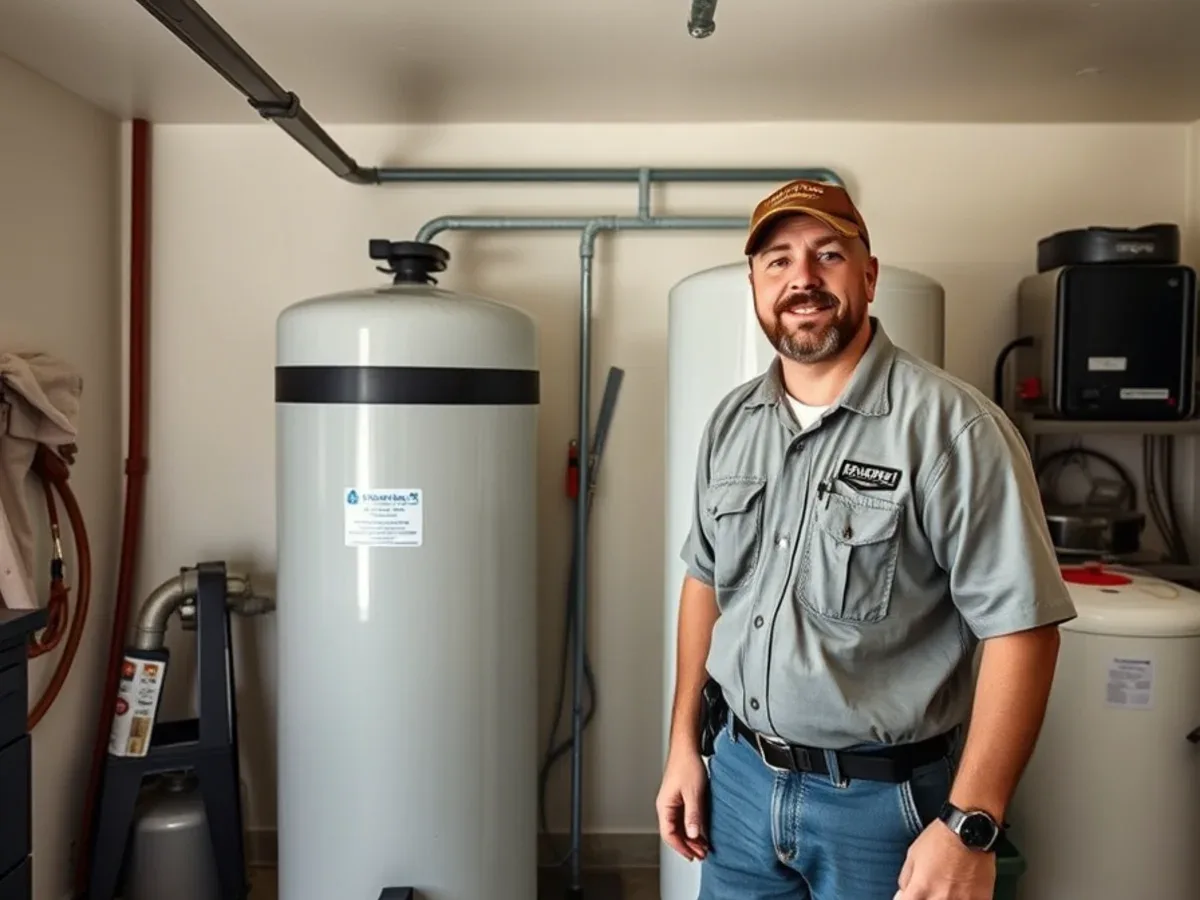
Properties in Gold Canyon, out toward Goldfield, and on the rural edges of Pinal County are frequently on private wells, and well chemistry here is not just "harder city water." Iron is the usual complaint — the orange-brown staining in toilets and sinks — often alongside manganese, hydrogen sulfide producing a rotten-egg smell, and sediment that varies seasonally and spikes after monsoon rain.
Putting a standard softener on untreated well water with high iron is a good way to ruin a resin bed. Iron fouls resin, and once it does, the unit loses capacity permanently. The right sequence is sediment filtration first, then iron and sulfur removal, then softening, then any point-of-use polishing. Getting that order wrong is expensive.
For well properties we start with a proper water test rather than a hardness strip, because you need to know iron, manganese, pH, TDS and bacteria before designing anything. We would rather send you for a lab test and design correctly than sell you a system that fails in eighteen months.
How a water treatment install runs
- 1
Test your actual water
On-site hardness testing free with any service call. Well properties get a full panel recommendation before we design anything.
- 2
Calculate real capacity
Hardness × household size × daily usage. Sizing on math, not on which unit is in the truck.
- 3
Design the sequence
Sediment, iron removal, softening, carbon and point-of-use in the correct order for your water chemistry.
- 4
Plumb it properly
Correct position in the line, bypass valve for service, drain and air gap to code, irrigation left on untreated water.
- 5
Program and commission
Metered regeneration set to your hardness and usage, resin bed conditioned, and a post-install test to confirm output.
- 6
Show you how to run it
Salt type and fill level, what the bypass does, when to expect regeneration, and what to watch for.
What drives the price
Water treatment quotes are free and written. The equipment range is wide because the right system depends entirely on what your water tests at.
- Grain capacity
- A correctly sized unit for a family of five on 22 grain water is a different machine from a two-person household on 15.
- Salt-based vs salt-free
- Conditioners have lower install cost and no ongoing salt; softeners cost more to run and deliver genuinely softened water.
- Whether you need pretreatment
- Well properties with iron, sulfur or heavy sediment need stages ahead of the softener. Skipping them destroys the resin.
- Plumbing at the install point
- A garage with an existing softener loop is quick. A house with no loop needs the line rerouted, a drain run and an outlet.
- Add-ons
- Whole-home carbon, UV disinfection on wells, and under-sink reverse osmosis are priced separately so you can choose.
Every quote is written, and the number does not change afterward. AZ ROC CR-37 Plumbing · BBB A+ accredited.
Why AllStar Home Services for water softeners
We will tell you when you do not need one
If you are on a well with iron, a softener installed first will foul its resin permanently. Iron removal comes first, and we will say so rather than sell you the wrong unit.
Free on-site water hardness test
We size treatment to your actual measured number rather than a citywide average, because an undersized unit is why people conclude softeners do not work.
The quote is the price
You hear the number before we start and it does not move afterward. It is the single thing customers mention most in our reviews.
4.7★ from 20 verified Google reviews
We publish every review including the two critical ones. A page of nothing but five stars tells you less than an honest one.
Where we provide water softeners
Hardness is regional, so this service runs everywhere we work. We deliver this from our 15th Ave shop across Apache Junction and Gold Canyon, then out through Queen Creek, San Tan Valley, Mesa, Gilbert, Chandler, Tempe and Fountain Hills. Newer subdivisions in Queen Creek, San Tan Valley, Maricopa and the post-2000 Apache Junction tracts were mostly plumbed with a garage softener loop that was never filled, which makes installation straightforward and much cheaper than a retrofit.
Further out we cover Florence, Coolidge, Casa Grande, Maricopa, Eloy, Superior and Mammoth, and we are honest about when a small job does not justify the drive. On well properties around Gold Canyon, Goldfield and rural Pinal County the design changes completely — sediment and iron removal have to come before softening, and that sequence should come off a lab panel.
- Water Softeners in Apache Junction
- Water Softeners in Gold Canyon
- Water Softeners in Queen Creek
- Water Softeners in Mesa
- Water Softeners in Superstition Mountain
- Water Softeners in Ironwood Estates
Water Softeners questions, answered
Related reading
 Hard Water
Do You Need a Water Softener in Apache Junction?
Salt-based or salt-free? What size? Will it taste salty? A straight answer to every water softener question we get asked in Apache Junction, including when the honest answer is that you do not need one.
8 min read Hard Water
How Hard Water in Apache Junction Destroys Your Plumbing
At 15 to 25 grains per gallon, Apache Junction has some of the hardest water in the country. Here is what that mineral is actually doing inside your pipes, your water heater and your fixtures — and the maintenance that changes the outcome.
7 min read