

Short answer
If one room in your Apache Junction home never cools, the cause is almost always ductwork rather than the air conditioner — a flex run separated from its collar in a 150-degree attic, a duct crushed by someone crawling past it, or a boot never sealed to the drywall. All of it is measurable, and all of it is fixable without new equipment.
In most Apache Junction homes the ductwork runs through the attic — and in July that attic reaches around 150 degrees. Every joint that has pulled apart, every run with crushed insulation, and every register boot that was never properly sealed is dumping cooled air into that space, or pulling superheated attic air into your supply.
The result is the complaint we hear constantly: one or two rooms that never cool properly no matter what the thermostat says, and a system that runs continuously without keeping up.
Duct problems are also the most measurable HVAC issue there is. Static pressure, temperature at the register versus at the air handler, and airflow at each outlet turn "the back bedroom is always hot" into numbers that point at a specific cause.
One room that never cools?
We measure static pressure and register airflow before recommending anything. The cause is usually specific and fixable.
What bad ductwork feels like
One room that never cools
A separated or crushed run, a closed damper, or a duct sized wrong for that room from the beginning.
Weak airflow at every register
System-wide restriction — a clogged filter, an undersized return, or duct that has collapsed somewhere.
The system runs constantly and never catches up
Cooled air escaping into the attic before it reaches the house. Common, and expensive every single month.
Dusty air and dust settling fast after cleaning
Unsealed returns and duct joints pulling attic dust straight into the supply air.
Rooms at very different temperatures
Distribution imbalance. Frequently fixable with damper adjustment and targeted sealing rather than new equipment.
A whistling or rushing noise at a register
Too much velocity through too small an opening, or a restriction immediately upstream.
What a ductwork job includes
Every quote covers the items below. If something is not on this list, it is not in the price — and we will say so before we start.
The system measured before anything is quoted
Total external static pressure, supply temperature at the air handler and at problem registers, and airflow at each outlet.
Physical inspection of every run
Somebody in the attic with a light and a camera, checking each connection, the insulation and the support — not a guess from the hallway.
A specific repair list by run
This run has separated at the plenum, this one is crushed at the truss, these three boots are unsealed. Not a general recommendation to redo the ductwork.
Sealing with mastic and mechanical fastening
At joints, plenums and register boots — including where the boot meets the drywall, which is where that grey shadow around your ceiling register comes from.
Damper balancing
Adjusted so rooms actually reach the same temperature, rather than compensating by dropping the thermostat.
Re-measured afterward
The same readings repeated so you can see the before-and-after numbers rather than taking our word for it.
Sealing versus cleaning — two different jobs
These get bundled together in advertising and they solve completely different problems. Being clear about which one you actually need saves money.
Duct sealing addresses leakage — air escaping from or entering the duct system where it should not. In an Arizona attic this is the one with the real financial return, because leaked cooled air is money that never reaches the house and infiltrated attic air is 150-degree air being mixed into your supply. Sealing is done with mastic and mechanical fasteners at joints, boots and plenums.
Duct cleaning removes accumulated dust and debris from the interior of the duct system. It is genuinely worthwhile after construction or renovation work, where there has been rodent or insect intrusion, if there has been water intrusion and microbial growth, or where dust is visibly discharging from registers. It is not a routine annual necessity for a normal home, and anyone selling it as one is overselling.
If someone quotes you duct cleaning for a comfort problem, ask whether they measured anything. A room that will not cool is almost always a leakage, sizing or damper problem, and cleaning will not change it.
Sealing
Fixes leakage and the money going into your attic. The one with a measurable return here.
Repair
Separated joints, crushed flex, damaged insulation and unsupported runs.
Balancing
Damper adjustment so rooms actually reach the same temperature.
Cleaning
Worthwhile after construction, intrusion or water damage. Not a routine annual item.
What goes wrong in an Arizona attic
Flexible duct is the standard in residential construction here, and it fails in characteristic ways once it has spent fifteen summers at 150 degrees.
Connections separate. The inner liner is clamped to a collar and the outer jacket taped over it, and years of thermal cycling loosens both. A run that has come off its collar entirely is discharging your air conditioning directly into the attic — and it is invisible from inside the house.
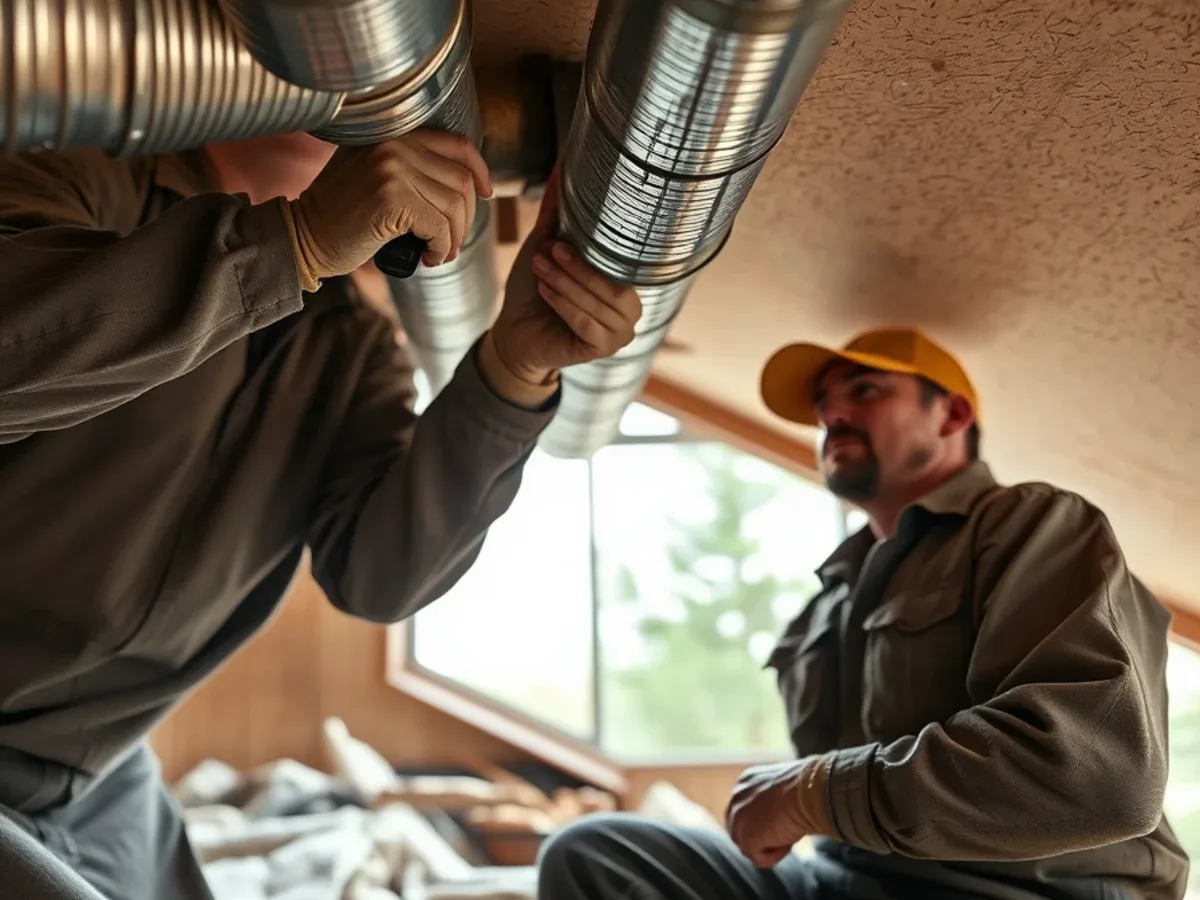
Flex gets crushed and kinked. Anyone who has crawled through an attic — an electrician, a cable installer, a previous HVAC tech — may have compressed a run to get past it. A crushed duct is a restriction that never recovers on its own.
Insulation degrades and tears, so the duct still delivers air but that air gains heat on the way. And long unsupported runs sag into low spots that behave like a restriction.
Register boots at ceilings are the other classic. Where the boot meets the drywall, an unsealed gap pulls attic air directly into the room around the register — which is why some ceiling registers have a permanent grey shadow of dust on the drywall around them.
Measuring before recommending
Duct work is easy to sell on vibes and easy to verify with instruments, and we would rather do the second.
We read total external static pressure at the air handler, which tells us immediately whether the system is fighting a restriction. We measure supply temperature at the air handler and at problem registers — a large difference across a run means either leakage or heat gain through poor insulation. We check airflow at each register to find the runs that are starved.
Then we inspect the runs themselves, which in practice means someone in the attic in the heat with a light and a camera, looking at every connection, the insulation, and the support.
What comes back is specific: this run has separated at the plenum, this one is crushed at the truss, these three boots are unsealed, and this room is short on airflow because the duct serving it is undersized for the room. That is a repair list, not a sales pitch.
How a ductwork job runs
- 1
Measure the system
Static pressure, supply temperatures and register airflow, so the problem is quantified before anyone quotes.
- 2
Inspect the runs
Physically, in the attic, with a light and a camera. Every connection, the insulation and the support.
- 3
Report what is actually wrong
A specific list by run and by register, not a general recommendation to redo the ductwork.
- 4
Repair and reconnect
Separated connections remade properly, crushed sections replaced, sagging runs supported, insulation restored.
- 5
Seal
Mastic and mechanical fastening at joints, plenums and register boots — including where boots meet drywall.
- 6
Balance and re-measure
Dampers adjusted, then the same measurements repeated so you can see the before-and-after numbers.
What drives the price
A duct assessment is a flat fee that applies toward the work. Repairs are quoted per run so you can see exactly what you are paying for.
- How many runs need work
- Reconnecting two separated joints is a short job. Replacing a dozen degraded runs is a project.
- Attic access
- A walkable attic with clearance is efficient. A low-slope roof with dense truss webbing genuinely doubles the time.
- Repair versus replacement
- Sealing and reconnecting sound flex is far cheaper than replacing runs whose insulation has failed.
- Sealing scope
- Plenum and boot sealing on an accessible system versus sealing an entire distribution system.
- Cleaning, if it is genuinely warranted
- Quoted separately, and we will tell you honestly when it is not the thing that will fix your comfort problem.
Every quote is written, and the number does not change afterward. AZ ROC CR-37 Plumbing · BBB A+ accredited.
Why AllStar Home Services for ductwork
We separate sealing from cleaning honestly
Duct cleaning is genuinely worthwhile after construction, intrusion or water damage. It will not fix a room that does not cool — that is leakage or sizing, and we will say so rather than sell you the wrong service.
Plumbing, HVAC and remodeling in one company
BBB accredits us under Plumber, Bathroom Remodel, Remodel Contractors and Drywall Repair. One contract, one crew, nobody pointing at somebody else.
The quote is the price
You hear the number before we start and it does not move afterward. It is the single thing customers mention most in our reviews.
16+ years in the trade, 60+ across the team
Shane is a master plumber who still writes the estimates and runs calls — which means more repairs and fewer replacements.
Where we provide ductwork
Attic ductwork is the regional norm, which makes this a common call everywhere we work. We deliver this from our 15th Ave shop across Apache Junction and Gold Canyon, then out through Queen Creek, San Tan Valley, Mesa, Gilbert, Chandler, Tempe and Fountain Hills.
Further out we cover Florence, Coolidge, Casa Grande, Maricopa, Eloy, Superior and Mammoth, and we are honest about when a small job does not justify the drive. Homes fifteen or more summers old are where connections have had the most thermal cycling to work loose — a run fully separated from its collar is dumping cooled air into the attic and is completely invisible from inside the house.
- Ductwork in Apache Junction
- Ductwork in Gold Canyon
- Ductwork in Queen Creek
- Ductwork in Mesa
- Ductwork in Superstition Mountain
- Ductwork in Ironwood Estates
Ductwork questions, answered
Related reading
 Seasonal
How to Prepare Your Plumbing for Arizona Summer Heat
Cold water that runs hot, hose bibs that split, attic lines at 150 degrees and a water heater in a 120-degree garage. Summer here is genuinely hard on plumbing.
6 min read Seasonal
Why Your AC Drain Line Keeps Clogging in Summer
Your air conditioner produces gallons of water a day in monsoon humidity. When the small pipe carrying it away blocks, that water finds your ceiling instead.
6 min read