
Short answer
A water heater flush in Apache Junction should be annual, not every five years. At 15–25 grains per gallon sediment builds roughly twice as fast as on soft water, and the flush only removes it while it is still loose — once it hardens into a crust on the tank floor, draining no longer takes it out.
This is the least glamorous service on this website and the one with the best return. A water heater in Apache Junction fights two things its manufacturer never designed for: 15 to 25 grains per gallon of dissolved mineral, and a garage that spends four months above 110 degrees.
The result is a tank rated for twelve years that routinely gives up at seven. The households that get twelve, fourteen, fifteen years out of the same equipment are almost always the ones where somebody flushed it and changed the anode rod.
That is the entire service. An hour, once a year, that pushes back a four-figure replacement by several years.
When was your water heater last flushed?
If you do not know, it has not been. One hour a year is the cheapest plumbing money you will spend here.
Signs your tank is overdue
Rumbling, popping or crackling
Water flashing to steam under a sediment crust. It is the audible signature of scale that has already built up.
Hot water runs out sooner than it used to
Sediment occupies volume. A scaled 50-gallon tank behaves like a 38-gallon tank and recovers slower too.
You have never flushed it
If you do not know when it was last done, it was not done. That is true of the overwhelming majority of tanks we open.
Rusty water on the hot side only
The anode rod is gone and the tank lining has started serving as the sacrificial metal. This one is a countdown.
Gas bill creeping up
Sediment insulates the burner from the water. You pay to heat rock before you heat water, every single cycle.
The T&P valve weeps
Often not a bad valve — usually thermal expansion with no working expansion tank to absorb it.
What a water heater flush job includes
Every quote covers the items below. If something is not on this list, it is not in the price — and we will say so before we start.
Safe isolation
Gas or breaker off, cold inlet closed, hot tap opened to break the vacuum. Nothing gets rushed around a pressurised tank.
A full flush, not a token drain
We cycle the cold inlet to stir the sediment bed so it leaves the tank with the water instead of resettling on the floor.
Anode rod pulled and assessed
The sacrificial component that corrodes instead of your tank. On this water the realistic interval is two to three years, not the standard five.
T&P valve operated and checked
Lifted and confirmed to discharge and reseal. A weeping T&P usually points to thermal expansion rather than a bad valve.
Expansion tank charge verified
Tapped and checked. A failed bladder means every heating cycle spikes pressure against the tank and every fixture in the house.
Static pressure and temperature set
Measured at a hose bib, and the thermostat set to 120°F — safer, cheaper to run, and it precipitates mineral considerably slower than 140.
What actually happens during a flush
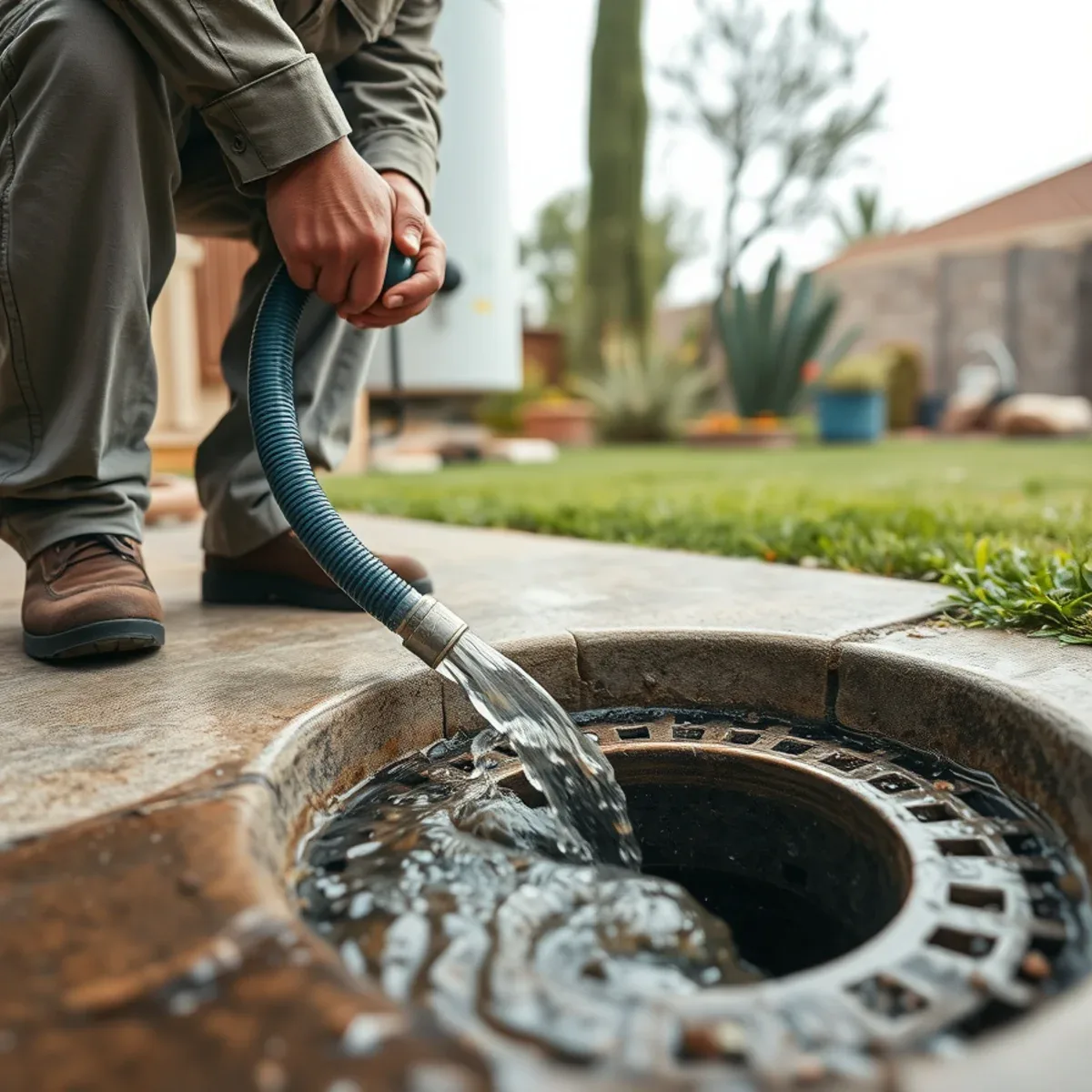
We shut off the gas or the breaker, close the cold inlet, connect to the drain valve and open a hot tap in the house to break the vacuum. Then we drain — and rather than pulling a few gallons and calling it done, we cycle the cold inlet to stir the sediment bed so it comes out with the water instead of staying packed on the floor of the tank.
The water that comes out tells you a lot. On an unflushed Apache Junction tank it is usually cloudy grey-white with visible grit, sometimes rust-brown. We show it to you, because a bucket of that is more persuasive than anything on this page.
One honest warning before you book: if your tank is over five years old and has never been flushed, tell us. On a badly scaled tank the original plastic drain valve sometimes will not reseal once it is opened. We carry replacement brass drain valves for exactly that situation, so a maintenance visit does not turn into an emergency.
The anode rod — the part nobody knows about
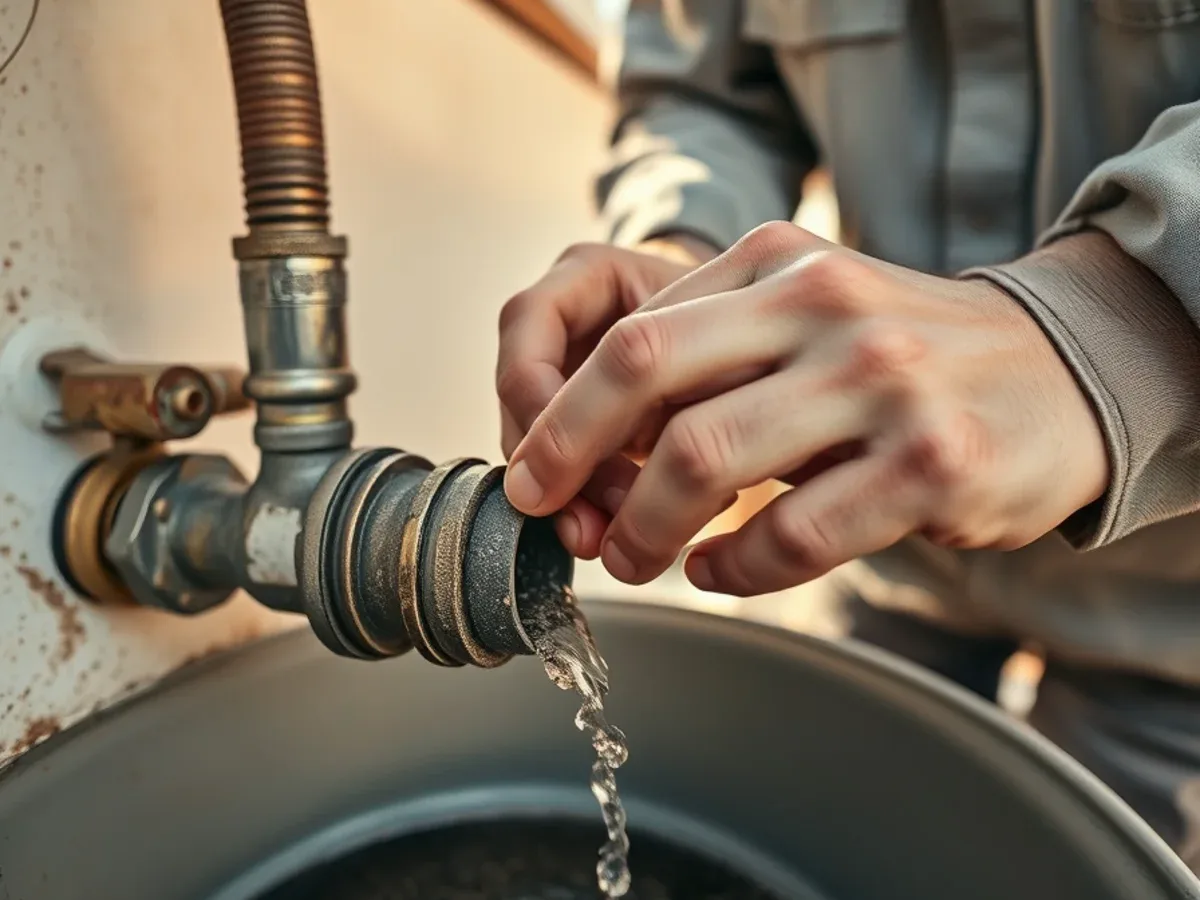
Threaded into the top of every tank water heater is a rod of magnesium or aluminum. Its entire job is to corrode instead of your tank. Galvanic action attacks the more reactive metal, so as long as that rod has material left, the steel vessel is protected.
When it is consumed, the tank becomes the sacrificial metal. From that point the clock is running and nothing reverses it.
Standard guidance says inspect at five years. That guidance is written for average water. On Apache Junction hardness, two to three years is the realistic interval, and we check it as part of every flush. Replacing one is a twenty-minute job that regularly adds years to a tank — and almost nobody does it, which is exactly why so few heaters here reach their rated life.
Magnesium rod
Most protective, consumed fastest. Factory default in most tanks.
Aluminum-zinc rod
Lasts longer and helps with sulfur smell. A good swap on well water producing hydrogen sulfide.
Powered anode
Uses a small impressed current instead of sacrificial metal. Costs more, essentially permanent.
Check every 2–3 years here
Not five. Local hardness eats rods considerably faster than average water.
What else we check while we are there
A flush visit is the right moment to catch the things that quietly shorten a tank's life. We test the T&P relief valve — lift the lever, confirm it discharges and reseals. If it weeps afterward, that usually points to a thermal expansion problem rather than a bad valve.
We check for a thermal expansion tank and verify its charge. Tap it: hollow at the top, solid at the bottom is correct. If the whole thing sounds solid, the bladder has failed and it is absorbing nothing, which means every heating cycle is spiking pressure against the tank and every fixture in your house.
We measure static water pressure at a hose bib. Anything above about 80 psi is actively damaging plumbing and is a genuine contributor to premature tank failure. And we set the thermostat to 120°F — hot enough for every household use, dramatically safer, and it precipitates mineral considerably slower than 140.
How a maintenance visit runs
- 1
Isolate safely
Gas or breaker off, cold inlet closed, hot tap opened to break the vacuum. Nothing gets rushed around a pressurised tank.
- 2
Full flush, not a token drain
We cycle the cold inlet to stir the sediment bed so it actually leaves the tank rather than resettling.
- 3
Anode inspection
Pulled and assessed. If it is spent we tell you, show you, and replace it with your approval.
- 4
Safety devices tested
T&P valve operated and checked for reseal, expansion tank charge verified, drain valve condition assessed.
- 5
Pressure and temperature
Static pressure measured at a hose bib, thermostat set to 120°F, combustion venting given a look.
- 6
Honest verdict
If the tank is genuinely past saving we say so rather than charging you to maintain something that is finished.
What drives the price
This is one of the more predictable jobs we price, and it is deliberately affordable because we would rather maintain your heater than sell you a new one early.
- Flush only, or full service
- A straight flush is the base. Adding the anode inspection, T&P test and pressure check is the version worth doing.
- Whether the anode needs replacing
- Parts cost plus a short labour add. On a tank under eight years old it is money very well spent.
- Drain valve condition
- Old plastic valves on heavily scaled tanks sometimes will not reseal. We carry brass replacements so it stays a maintenance visit.
- Access
- A garage install is quick. An interior closet, an attic platform or a tight manufactured-home alcove takes longer.
- Doing several at once
- Rentals and multi-unit properties are priced per unit at a lower rate when they are done in one visit.
Every quote is written, and the number does not change afterward. AZ ROC CR-37 Plumbing · BBB A+ accredited.
Why AllStar Home Services for water heater flush
We carry brass drain valves
On a badly scaled tank the original plastic valve sometimes will not reseal once opened. We bring the replacement so a maintenance visit does not become an emergency.
The quote is the price
You hear the number before we start and it does not move afterward. It is the single thing customers mention most in our reviews.
16+ years in the trade, 60+ across the team
Shane is a master plumber who still writes the estimates and runs calls — which means more repairs and fewer replacements.
Based at 870 W 15th Ave, not a call centre
Shane, Leo and Justin live in Apache Junction. Most of the city is a ten to fifteen minute drive rather than a cross-valley dispatch.
Where we provide water heater flush
Hardness is regional, so every household we serve benefits from this. We deliver this from our 15th Ave shop across Apache Junction and Gold Canyon, then out through Queen Creek, San Tan Valley, Mesa, Gilbert, Chandler, Tempe and Fountain Hills.
Further out we cover Florence, Coolidge, Casa Grande, Maricopa, Eloy, Superior and Mammoth, and we are honest about when a small job does not justify the drive. For rental portfolios and multi-unit properties we price per-unit maintenance at a lower rate when several are done in one visit, which is far cheaper than a failed heater in an occupied unit.
- Water Heater Flush in Apache Junction
- Water Heater Flush in Gold Canyon
- Water Heater Flush in Queen Creek
- Water Heater Flush in Mesa
- Water Heater Flush in Superstition Mountain
- Water Heater Flush in Ironwood Estates
Water Heater Flush questions, answered
Related reading
 Water Heaters
Why Arizona Heat Is Destroying Your Water Heater
A water heater in a 120-degree Arizona garage, fed by 20-grain water, is fighting a battle it was not designed for. Two maintenance items decide whether you get seven years or fifteen.
7 min read Hard Water
How Hard Water in Apache Junction Destroys Your Plumbing
At 15 to 25 grains per gallon, Apache Junction has some of the hardest water in the country. Here is what that mineral is actually doing inside your pipes, your water heater and your fixtures — and the maintenance that changes the outcome.
7 min read