
Short answer
Whole-home water filtration in Apache Junction solves what a softener cannot: chlorine, taste, odor and sediment. A softener removes hardness and nothing else — so if your water is gentle on the fixtures but still tastes like a pool, filtration is the missing half, and carbon placed ahead of the softener also extends its resin life.
A water softener and a whole-home filter get talked about as if they are the same purchase. They are not, and confusing them is why plenty of Apache Junction homeowners install a softener and are then surprised the water still tastes like a swimming pool.
A softener removes hardness — calcium and magnesium. That is a plumbing and appliance problem, and softening solves it. It does nothing for chlorine, taste, odor, sediment or the fine grit that packs aerators and scores cartridge seals.
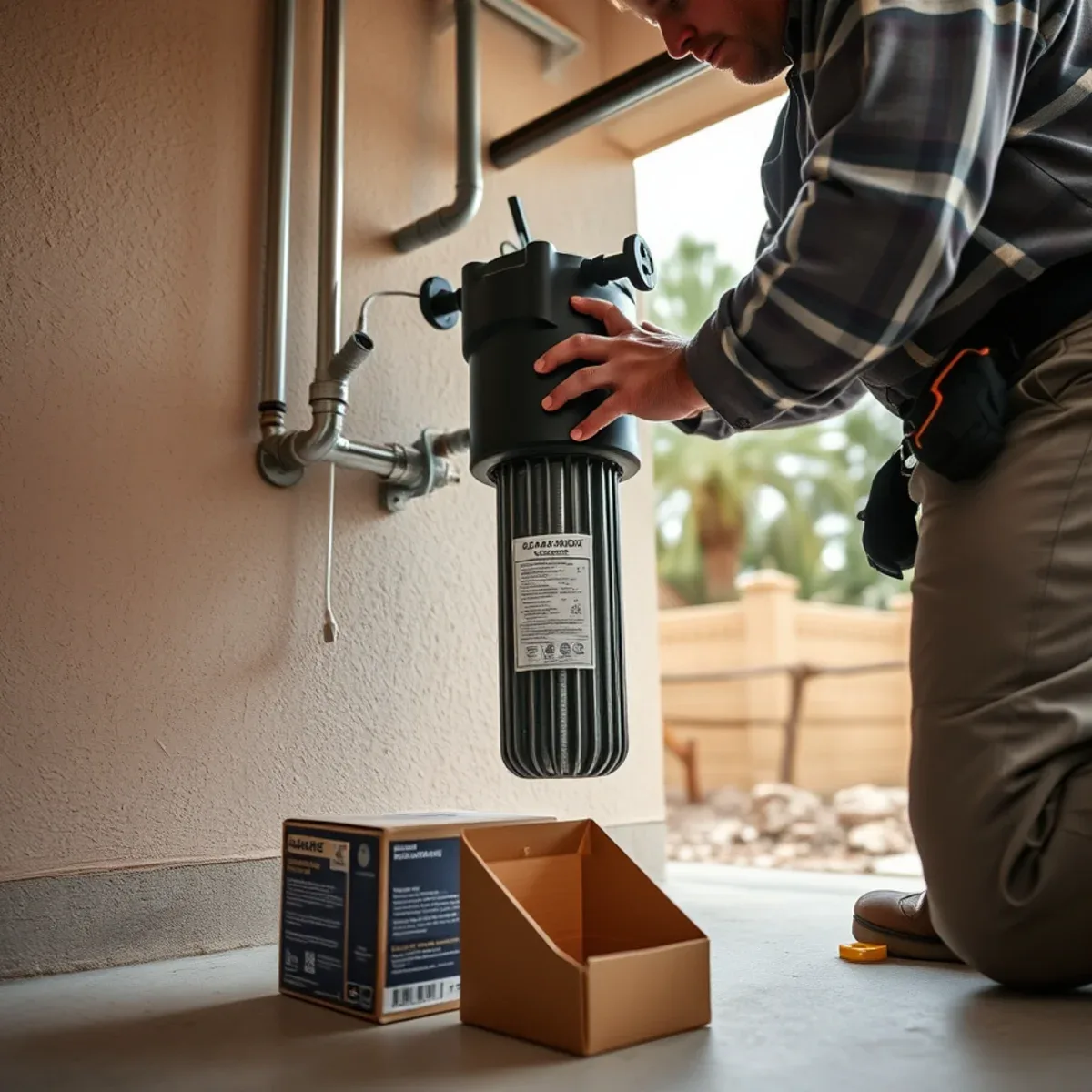
Whole-home filtration is the other half. Carbon media removes chlorine and chloramine, which is what makes the water actually pleasant rather than merely gentle on plumbing. Sediment filtration catches particulate before it reaches anything with a moving part. Together with softening, that is the complete answer for a house on municipal supply here.
Soft water that still tastes like chlorine?
Free on-site test, and a straight recommendation on what your water actually needs — including when the answer is nothing.
What filtration fixes that softening does not
Water that tastes or smells like chlorine
Chloramine in treated supply. Carbon media removes it — no softener will, at any size.
Grit in aerators and showerheads
Particulate from the main and from older pipe. A sediment stage catches it before it reaches your fixtures.
Dry skin and hair even with soft water
Frequently chlorine rather than hardness. This is the complaint most often misattributed to a softener not working.
A softener resin bed that is not lasting
Chlorine degrades softener resin over time. Carbon filtration ahead of it protects the investment.
PEX and rubber components ageing early
Chlorine attacks elastomers — washers, O-rings, flexible connectors, and PEX itself over a long enough horizon.
Cloudy water at the tap
Usually entrained air, sometimes fine sediment. We test rather than guess, because the fixes differ.
What a whole-home filtration job includes
Every quote covers the items below. If something is not on this list, it is not in the price — and we will say so before we start.
Water tested before anything is designed
Hardness on site free with any service call, plus a recommended lab panel on well properties before a system is specified.
The sequence designed correctly
Sediment, then carbon, then softening, then point-of-use. Building it out of order means replacing media that an earlier stage should have protected.
Sized for peak flow, not square footage
Undersized media starves the house whenever two fixtures run at once, which is the most common complaint on systems installed by someone else.
Bypass valves on every stage
So any single stage can be isolated for service without shutting down the house.
Drain connection with a proper air gap
To code, so there is no backflow path from the drain into your treated water.
Commissioned with a before-and-after test
Media conditioned, control heads programmed, and output measured so you can see exactly what changed.
Getting the order right
Sequence matters more than brand, and this is the single most common thing we correct on systems installed by someone else.
Sediment filtration goes first. Its job is to protect everything downstream from particulate, and a spin-down separator or cartridge filter sized to the actual sediment load is inexpensive insurance for the tanks behind it.
Carbon comes next, removing chlorine and chloramine. Placing carbon ahead of the softener rather than behind it is deliberate: chlorine shortens resin life, so filtering it out first extends the softener's working life meaningfully.
Softening goes last in the main train, handling hardness on water that has already been cleaned up. Then any point-of-use polishing — reverse osmosis at the kitchen tap — sits at the very end.
Get that order backwards and you spend money replacing media and resin that a cheaper upstream stage should have protected.
1 — Sediment
Spin-down or cartridge, sized to actual load. Protects every stage behind it.
2 — Carbon
Removes chlorine, chloramine, taste and odor. Also extends softener resin life.
3 — Softener
Handles hardness, on water that has already been filtered.
4 — Point of use
Reverse osmosis at the kitchen tap for drinking and cooking water.
Backwashing tanks versus cartridge systems
There are two ways to do whole-home carbon and they suit different households.
A backwashing carbon tank uses a control head that periodically reverses flow to clean and re-bed the media. There are no cartridges to buy, the media lasts years before it needs replacing, and flow rate stays high across the whole house. It needs a drain connection and an outlet, and it uses some water to backwash.
A large-format cartridge system uses replaceable filter elements in housings. Lower up-front cost, no drain needed, no electricity — but you are buying cartridges on a schedule, and a neglected cartridge becomes a deliberate restriction in your main line. We find plenty of low-pressure complaints that turn out to be a filter cartridge nobody has changed in three years.
For a full-size household on municipal supply here, we usually recommend backwashing tanks. For a smaller home, a part-year property, or a situation where a drain connection is genuinely impractical, cartridges are a sensible choice — as long as somebody actually changes them.
Well properties are a different design
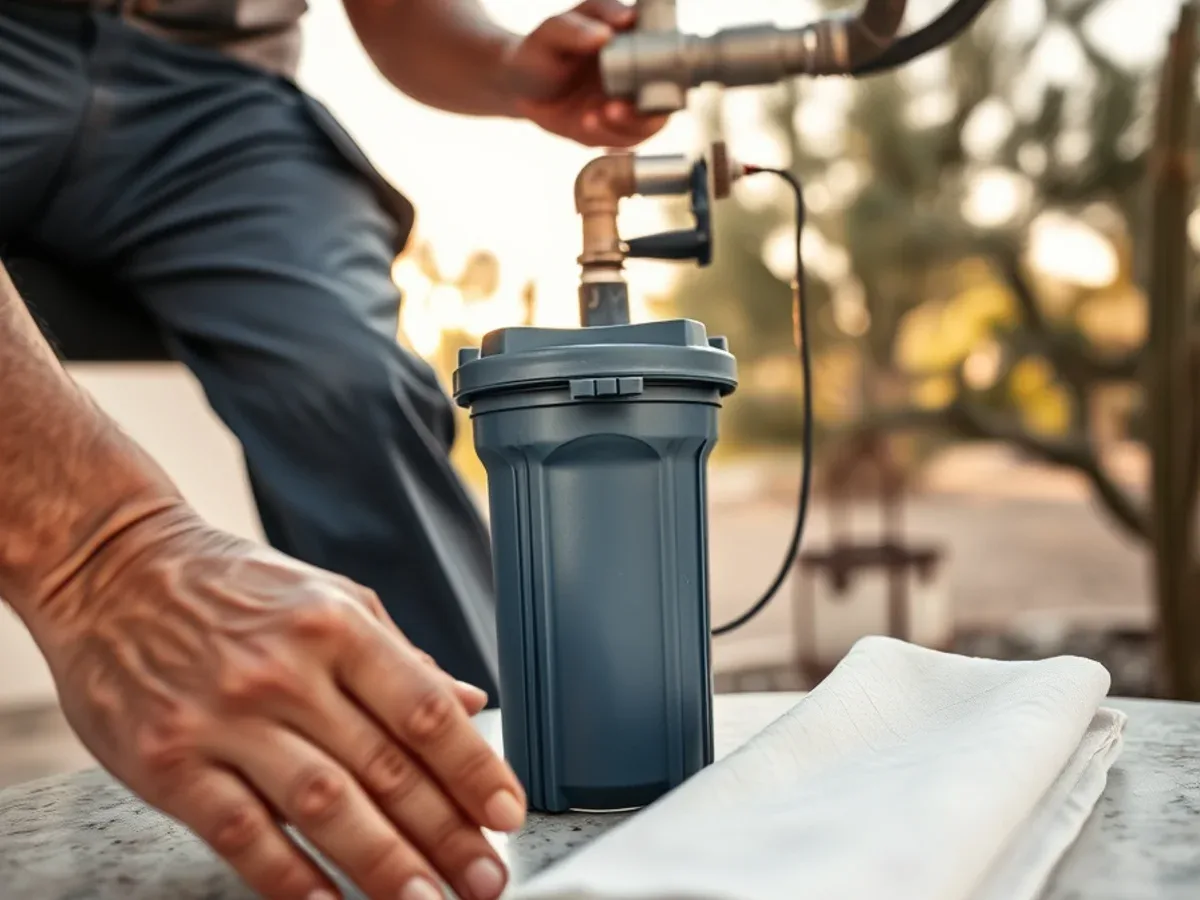
Everything above assumes treated municipal supply. If you are on a private well in Gold Canyon, out toward Goldfield or through rural Pinal County, the design changes substantially.
Well water here commonly carries dissolved iron, sometimes manganese, frequently hydrogen sulfide, and a sediment load that swings seasonally and spikes after monsoon recharge. Chlorine, meanwhile, is not present at all — so a carbon stage aimed at chlorine is solving a problem you do not have.
On a well the sequence becomes sediment, then oxidation and iron and sulfur removal, then softening, then UV disinfection where bacteria are present. And it should be designed off an actual lab panel rather than a test strip, because guessing at well chemistry produces equipment that fails early.
How a filtration install runs
- 1
Test the water
Hardness on site free with any service call, plus a recommended lab panel for well properties before anything is designed.
- 2
Design the sequence
Sediment, carbon, softening and point-of-use in the correct order for your actual water, not a generic package.
- 3
Size for flow, not just house size
Peak simultaneous demand determines tank size. Undersized media starves the house whenever two fixtures run.
- 4
Plumb it properly
Correct position after the main shutoff and regulator, bypass valves on every stage for service, drain with a proper air gap.
- 5
Commission and verify
Media conditioned, control heads programmed, and a post-install test so you can see what changed.
- 6
Set the maintenance interval
Media life, cartridge schedule and what to watch for — written down, not explained once and forgotten.
What drives the price
Quoted free and in writing after we test your water. The range is genuinely wide because the right system depends entirely on what is in it.
- How many stages you actually need
- Municipal supply often needs two. A well with iron, sulfur and sediment can need four before softening is even reached.
- Tank or cartridge
- Backwashing tanks cost more up front and less to run. Cartridges are cheaper to install and cost you on a schedule.
- Flow rate required
- A three-bathroom house running two showers needs larger media beds than a two-person household.
- Plumbing at the install point
- An existing softener loop makes this straightforward. No loop means rerouting the main, adding a drain and an outlet.
- Whether you are adding softening at the same time
- Doing filtration and softening together costs meaningfully less than two separate visits and two separate plumbing jobs.
Every quote is written, and the number does not change afterward. AZ ROC CR-37 Plumbing · BBB A+ accredited.
Why AllStar Home Services for whole-home filtration
We will tell you which half you actually need
Plenty of people buy filtration when the complaint is hardness, or a softener when the complaint is taste. Testing first is how you avoid buying the wrong box.
Free on-site water hardness test
We size treatment to your measured number rather than a citywide average, because undersizing is why people conclude treatment does not work.
The quote is the price
You hear the number before we start and it does not move afterward. It is the single thing customers mention most in our reviews.
16+ years in the trade, 60+ across the team
Shane is a master plumber who still writes the estimates and runs calls — which means more repairs and fewer replacements.
Where we provide whole-home filtration
Municipal supply across this region is both hard and chlorinated, so most households benefit from both stages. We deliver this from our 15th Ave shop across Apache Junction and Gold Canyon, then out through Queen Creek, San Tan Valley, Mesa, Gilbert, Chandler, Tempe and Fountain Hills.
Further out we cover Florence, Coolidge, Casa Grande, Maricopa, Eloy, Superior and Mammoth, and we are honest about when a small job does not justify the drive. On well properties around Gold Canyon, Goldfield and rural Pinal County the design is completely different — there is no chlorine to remove, and iron, manganese and hydrogen sulfide have to be dealt with before softening rather than after.
- Whole-Home Filtration in Apache Junction
- Whole-Home Filtration in Gold Canyon
- Whole-Home Filtration in Queen Creek
- Whole-Home Filtration in Mesa
- Whole-Home Filtration in Superstition Mountain
- Whole-Home Filtration in Ironwood Estates
Whole-Home Filtration questions, answered
Related reading
 Hard Water
How Hard Water in Apache Junction Destroys Your Plumbing
At 15 to 25 grains per gallon, Apache Junction has some of the hardest water in the country. Here is what that mineral is actually doing inside your pipes, your water heater and your fixtures — and the maintenance that changes the outcome.
7 min read Well Water
Well Water vs. City Water in Pinal County
On city water somebody else is the utility. On a well, you are. Here is everything that changes — testing, treatment, equipment life and what to check before you buy.
8 min read