
Short answer
An AC tune-up earns its keep in Apache Junction in a way it might not in a mild climate. Equipment here runs near-continuously for months well past its 95°F rating, capacitors fail in unshaded outdoor units, condenser coils foul with desert dust, and condensate lines sludge shut and come through ceilings — and all three are catchable in spring.
Manufacturers rate air conditioning equipment at 95 degrees. Apache Junction spends much of the summer well above that, and an attic-mounted air handler can sit in 150-degree ambient conditions. Equipment here runs near-continuously for months in conditions it was never designed around.
That is why annual maintenance is genuinely worth it in this climate in a way it might not be somewhere mild. It is not a tick-box service — the specific things that fail here are predictable, and most of them are cheap to catch and expensive to ignore.
The best time is spring, before the first real heat. A capacitor tested and replaced in April costs a fraction of the same part replaced at 5pm on a 113-degree Saturday in July, and the difference in how your week goes is larger still.
Book it in spring, not in August.
A capacitor tested in April costs a fraction of the same part at 5pm on a 113-degree Saturday.
What maintenance actually catches
A capacitor about to fail
Heat-sensitive components sitting in an unshaded outdoor unit. The single most common no-cool call in this region, and testable in advance.
A condenser coil packed with dust
A fouled coil cannot reject heat, which raises head pressure and stresses the compressor continuously.
A condensate drain starting to sludge
Clear it in spring and it carries the monsoon load. Leave it and it comes through a ceiling in July.
A disconnected float switch
Plenty get bypassed by whoever was annoyed by one last summer — removing the only automatic protection your drywall has.
Refrigerant charge drifting
Low charge costs efficiency long before it stops cooling, and running low charge damages compressors.
Duct connections that have separated
Years of thermal cycling in a hot attic pulls joints apart, dumping expensive cold air where nobody lives.
What a hvac maintenance job includes
Every quote covers the items below. If something is not on this list, it is not in the price — and we will say so before we start.
Baseline measurements taken first
Temperature split, static pressure and electrical readings recorded before anything is cleaned, so we can show you the difference after.
Capacitor tested against its rated value
Measured, not eyeballed. This catches the single most common no-cool failure in this region before it strands you in July.
Condenser coil properly cleaned
Not rinsed. A fouled coil cannot reject heat, which raises head pressure and stresses the compressor continuously.
Condensate line cleared and float switch tested
We physically raise the float to confirm it shuts the system down. Plenty have been disconnected by whoever was annoyed by one last summer.
Charge verified against design
Superheat or subcooling measured properly rather than topped up on a hunch, which is how systems end up overcharged.
An honest prioritised report
What is fine, what is marginal and what we would address before next summer — without scare tactics.
What a real tune-up includes
There is a wide gap in this industry between a genuine maintenance visit and a filter change with a sticker on the unit. Here is what ours covers.
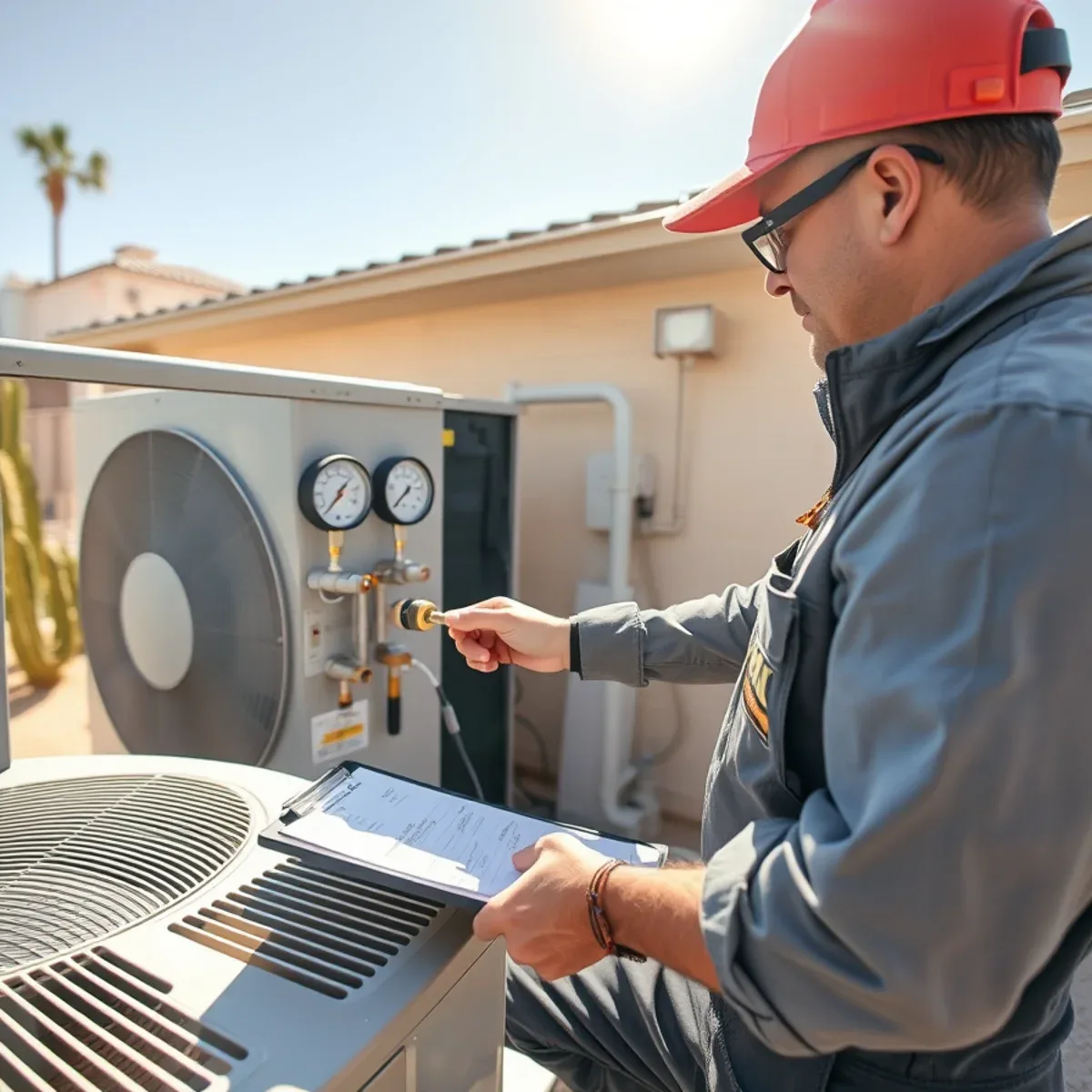
Outside: condenser coil cleaned properly rather than rinsed, fan motor and blades inspected, contactor checked for pitting, capacitor tested against its rated microfarads rather than just looked at, electrical connections tightened, and refrigerant pressures and superheat or subcooling measured against design.
Inside: evaporator coil inspected and cleaned where accessible, blower wheel checked for dust loading, filter replaced, temperature rise or split measured, static pressure read, and safety controls verified.
Condensate: line cleared, drain pan inspected for rust-through, float switch tested by actually raising it, and algaecide tablets placed. On Arizona systems this is the part that most often prevents a ceiling repair.
And on gas heating equipment in autumn: heat exchanger inspection, venting verified, combustion checked and CO alarms confirmed present and in date.
Capacitor tested, not eyeballed
Measured against rated microfarads. Catches the most common failure before it strands you.
Coils actually cleaned
Not rinsed. A fouled condenser is a compressor problem waiting to happen.
Condensate cleared and float tested
The item that most often prevents a summer ceiling repair.
Charge measured against design
Superheat or subcooling, not a guess from the low side gauge.
The filter, and why it matters more here
The cheapest maintenance item is the one most people get wrong in both directions.
Dust load in this environment is high — gravel yards, open desert, construction, and monsoon dust events. A filter that would last three months elsewhere loads up much faster here, and a clogged filter restricts airflow, which drops coil temperature, which can freeze the evaporator and starve the system.
The other direction is over-filtering. A very high MERV filter in a system not designed for it creates static pressure the blower cannot overcome, and the result is poor airflow, poor cooling and a strained motor. Higher is not automatically better.
For most Apache Junction homes a mid-range pleated filter changed every one to three months during cooling season is right. If anyone in the house has allergies, a better filter in a system sized for it is worth having — but that is a static pressure question, not a shopping question, and we will measure rather than guess.
Maintenance agreements, honestly
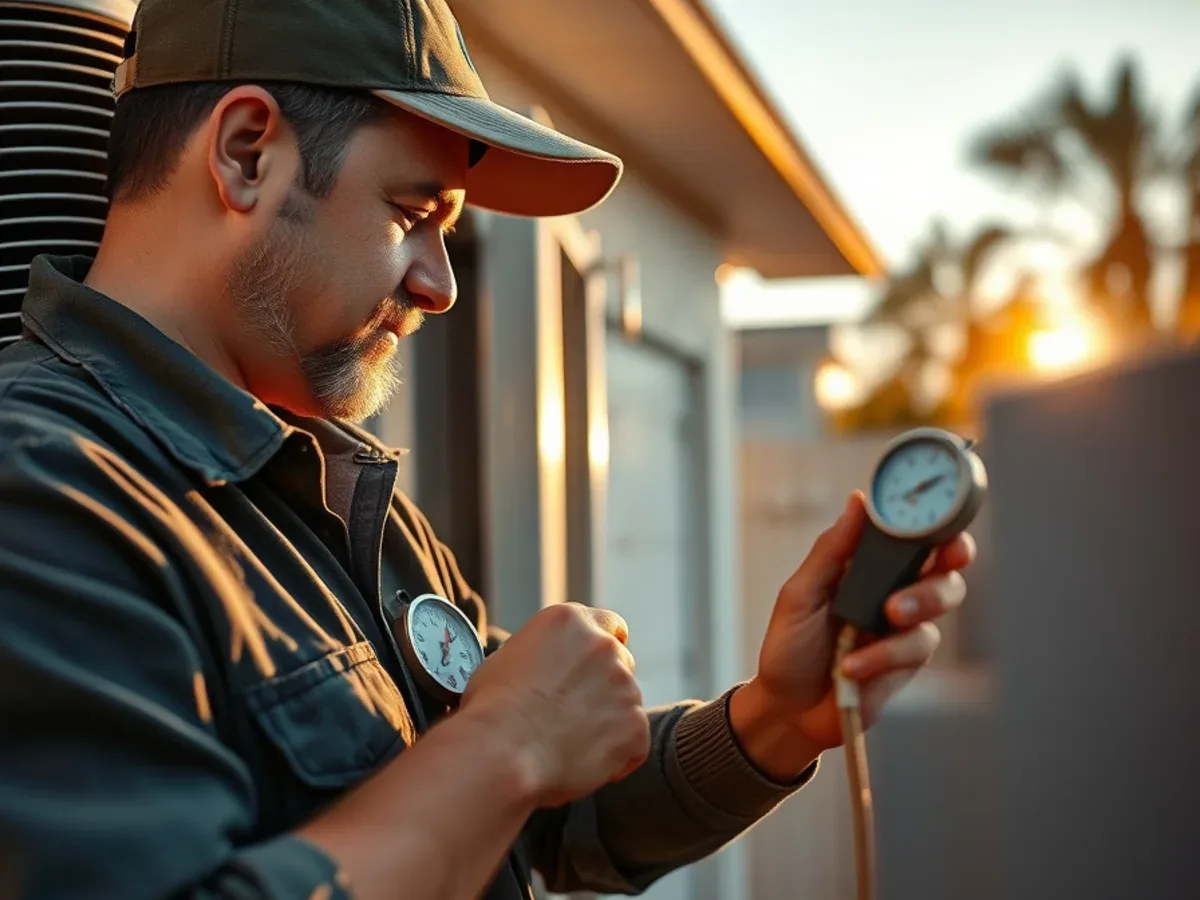
We offer them and we will also tell you plainly what they are and are not.
What they genuinely give you: scheduled visits that actually happen rather than ones you meant to book, priority scheduling when something breaks in peak season, and a discounted rate on repairs. For rental properties and for households where nobody is going to remember to call in April, that scheduling discipline is most of the value.
What they are not: a warranty, or a guarantee nothing will fail. Equipment fails. Maintenance shifts the odds meaningfully and reduces the number of failures that happen at the worst possible moment.
If you are diligent about calling each spring on your own, you do not need an agreement and we will say so. The service is the same either way.
How a tune-up visit runs
- 1
Baseline measurements
Temperature split, static pressure and electrical readings taken before anything is cleaned, so we can show the difference after.
- 2
Outdoor unit service
Coil cleaned, fan and contactor inspected, capacitor tested against rating, connections tightened.
- 3
Indoor unit service
Evaporator and blower inspected, filter replaced, drain pan and safety controls checked.
- 4
Condensate system
Line cleared, float switch physically tested, pan inspected for corrosion, algaecide placed.
- 5
Charge and airflow verified
Superheat or subcooling measured against design rather than topped up on a hunch.
- 6
Honest report
What is fine, what is marginal, and what we would address before next summer — prioritised, without scare tactics.
What drives the price
A flat rate per system, with multi-system and multi-property pricing available. Any repairs found are quoted separately before we do them.
- Number of systems
- Homes with two or three units are priced per system at a reduced rate when done in one visit.
- Cooling only or cooling and heating
- A spring cooling tune-up and an autumn heating check are separate visits, and cheaper booked together.
- Access
- A ground-level condenser and a walkable attic are straightforward. Rooftop packages and low-clearance attics take longer.
- Condition on arrival
- A system maintained annually is a shorter visit than one that has not been touched in six years and needs a deep clean.
- Agreement or one-off
- Agreement customers get a lower per-visit rate, priority scheduling in peak season and a repair discount.
Every quote is written, and the number does not change afterward. AZ ROC CR-37 Plumbing · BBB A+ accredited.
Why AllStar Home Services for hvac maintenance
We will tell you if an agreement is not worth it
If you reliably call each spring on your own, you do not need one — the service is identical either way. What an agreement buys is scheduling discipline and priority in peak season.
Plumbing, HVAC and remodeling in one company
BBB accredits us under Plumber, Bathroom Remodel, Remodel Contractors and Drywall Repair. One contract, one crew, nobody pointing at somebody else.
The quote is the price
You hear the number before we start and it does not move afterward. It is the single thing customers mention most in our reviews.
4.7★ from 20 verified Google reviews
We publish every review including the two critical ones. A page of nothing but five stars tells you less than an honest one.
Where we provide hvac maintenance
Spring tune-ups book out fast, and June is too late. We deliver this from our 15th Ave shop across Apache Junction and Gold Canyon, then out through Queen Creek, San Tan Valley, Mesa, Gilbert, Chandler, Tempe and Fountain Hills.
Further out we cover Florence, Coolidge, Casa Grande, Maricopa, Eloy, Superior and Mammoth, and we are honest about when a small job does not justify the drive. Attic-mounted air handlers are common across this region's newer construction and are the worst case for condensate failures — worth prioritising if yours is up there, because an overflow puts water through a ceiling rather than onto a garage floor.
- HVAC Maintenance in Apache Junction
- HVAC Maintenance in Gold Canyon
- HVAC Maintenance in Queen Creek
- HVAC Maintenance in Mesa
- HVAC Maintenance in Superstition Mountain
- HVAC Maintenance in Ironwood Estates
HVAC Maintenance questions, answered
Related reading
 Seasonal
Why Your AC Drain Line Keeps Clogging in Summer
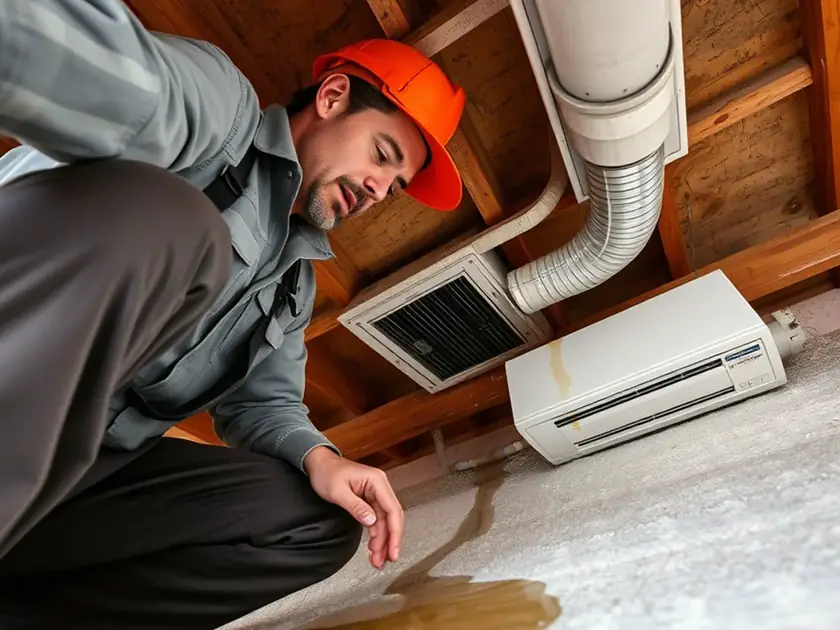
Your air conditioner produces gallons of water a day in monsoon humidity. When the small pipe carrying it away blocks, that water finds your ceiling instead.
6 min read Seasonal
How to Prepare Your Plumbing for Arizona Summer Heat
Cold water that runs hot, hose bibs that split, attic lines at 150 degrees and a water heater in a 120-degree garage. Summer here is genuinely hard on plumbing.
6 min read