Winter Plumbing Tips for Desert Homes: Yes, It Gets Cold Enough
Everyone assumes freezing is not an Arizona problem. Then a cold snap arrives, and the hose bibs and exposed lines that nobody protected split.
The short answer
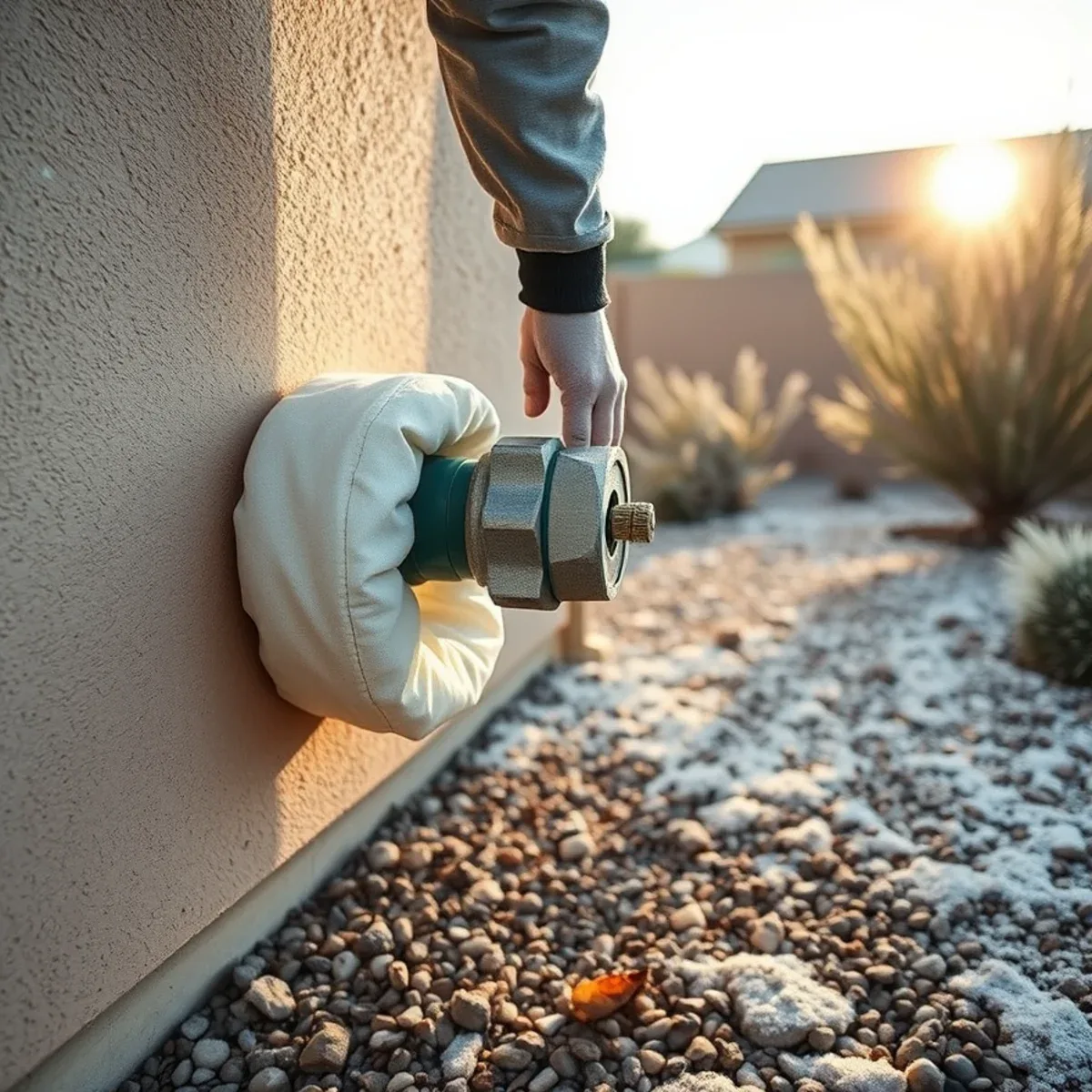
Apache Junction does hit freezing, and the exposure is all exterior. Disconnect garden hoses — a connected hose traps water in the bib and is behind most freeze damage here. Fit insulated bib covers, drain or cover irrigation backflow assemblies, and shut the main off if you leave for a stretch.
The most common thing we hear in January is some version of "I did not think pipes could freeze here." They can, and they do — not often, and not everywhere, but reliably enough that a handful of calls every winter come from split hose bibs and exposed lines.
Apache Junction sits at around 1,700 feet, and overnight lows in the 30s are normal through December and January. A hard freeze below 32 happens most winters. Properties at higher elevation — up toward Superstition Mountain, out through Gold Canyon, and out in Superior — run several degrees colder than the valley floor and see it more often.
The exposure here is different from a cold climate, though. Interior plumbing in a heated house is fine. It is the exterior and unconditioned stuff that gets you, and almost all of it is protected with about twenty minutes of work.
Hose bibs are the number one casualty
Almost every freeze call we take is an exterior faucet, and the mechanism is nearly always the same: a hose left connected.
A connected hose keeps water trapped in the bib and in the short run of pipe behind it. When that water freezes it expands, and the split usually happens inside the wall rather than at the visible faucet — which is why people discover it in spring when they turn the water on and it comes out inside the house.
The fix is three steps and it takes minutes. Disconnect every hose before winter. Shut off the interior valve serving the hose bib if one exists, then open the bib to drain the line behind it. Fit an insulated hose bib cover — they cost a few dollars and they are the single best value in freeze protection.
If you have frost-free bibs, they self-drain when properly installed at a slight downward pitch — but only if the hose is disconnected. A frost-free bib with a hose attached is not frost-free.
Disconnect hoses
The single most important step. A connected hose defeats even a frost-free bib.
Drain the bib
Shut the interior valve if there is one, then open the faucet to empty the line behind it.
Insulated covers
A few dollars each. The best value in the whole article.
Wrap exposed runs
Foam sleeve on anything running along an exterior wall or through an unheated space.
Where else the exposure is
Beyond hose bibs, the vulnerable spots in a desert home are all places where plumbing leaves conditioned space.
Irrigation backflow assemblies sit above ground, are full of water, and are made partly of brass and plastic that split readily. They are one of the most common freeze losses in this region. Insulated covers, or draining and shutting the system down for winter, both work.
Pool and spa equipment — pumps, filters and heaters — hold water and are outdoors. Most pool equipment has drain plugs for exactly this, and running the pump through the coldest hours also prevents standing water freezing.
Plumbing in an unheated garage, in an exterior wall on the north side, or running through a crawlspace under a manufactured home is worth insulating. Manufactured homes deserve particular mention: supply lines in the underbelly have far less protection than lines inside a slab-on-grade house, and skirting that has come loose lets cold air circulate directly around them.
Water heaters in an unheated garage are generally fine — they are full of hot water — but the flexible connectors and the T&P discharge line are not, and a discharge line that runs outside can freeze and block.
What to do when a hard freeze is forecast
On the handful of nights a year when it genuinely matters, these take ten minutes.
Disconnect hoses if you have not already, and fit covers. Open cabinet doors under sinks on exterior walls so household heat reaches the pipes. Let a faucet on the most exposed run drip overnight — moving water is far harder to freeze, and the trickle costs almost nothing.
If your irrigation system is not winterised, shut it off at the valve and drain the backflow assembly. Cover pool equipment or run the pump through the coldest hours.
And leave the heat on. Setting a thermostat back aggressively while you are out on the coldest night of the year is exactly the wrong time to save a few dollars — keep it above 55°F.
If you are a snowbird, this changes everything
A property that sits empty through summer is the more common Apache Junction pattern, but plenty of people leave for part of winter too — and an unoccupied house in a cold snap has no household heat protecting anything.
The safe approach for any extended absence: shut off the main water valve to the whole house, open a couple of faucets to relieve residual pressure, and turn the water heater to vacation mode or off entirely.
With the main off and the system depressurised, a freeze cannot do meaningful damage because there is very little water to expand and no supply feeding a split.
Also arrange for someone to check the property periodically, particularly after any weather event. And consider a smart leak detection device with automatic shutoff, which turns a catastrophic failure in an empty house into a phone call. For a part-year property that is genuinely the highest-value plumbing purchase available.
The heating test that belongs in this article
The other winter plumbing problem in Apache Junction is not freezing at all — it is a furnace or heat pump that has sat unused since spring being asked for heat on the first cold night.
Eight or nine months idle lets dust settle on burners and heat exchangers, lets a flame sensor build residue, and lets a heat pump reversing valve stick in one position. That is why the same week every November produces a wave of no-heat calls.
Run the heat for fifteen minutes some evening in October, before you need it. That surfaces almost every fault while it is still a scheduling matter rather than an emergency on a 34-degree night. Expect a burning smell for a few minutes — that is dust burning off and it is normal. If it persists beyond ten minutes or smells electrical, shut it off and call.
And check your carbon monoxide alarms while you are at it. They have a service life of seven to ten years printed on the unit, and an expired CO alarm in a house with gas heating is not protection.
Frequently asked questions
Twenty minutes in November
Disconnect the hoses, fit bib covers, deal with the irrigation backflow, and run the heat for fifteen minutes in October. That is essentially the whole list, and it prevents nearly every winter call we take.
If something has already split, shut the main off and call us — and if you are heading out of town for a stretch, we are happy to do a shutdown check before you go.
Services mentioned in this article
- Faucets & Fixturesin Apache Junction, AZ
- Heating & Furnacein Apache Junction, AZ
- Backflow Testingin Apache Junction, AZ